5 Days in Interlaken 2026: The Perfect Swiss Alps Trip
The Heart of the Bernese Alps
Interlaken is famous for adventure sports, hiking, scenic views. This 5 Days in Interlaken journey, which begins from the Spanish town of Madrid, is headed to the breathtaking valley of Interlaken in the Bernese Oberland region of Switzerland. It is a small alpine town nestled gently between two glacial lakes, Lake Thun on one side and Lake Brienz on the other, with the towering peaks of the Eiger, Monch and Jungfrau standing guard over it.
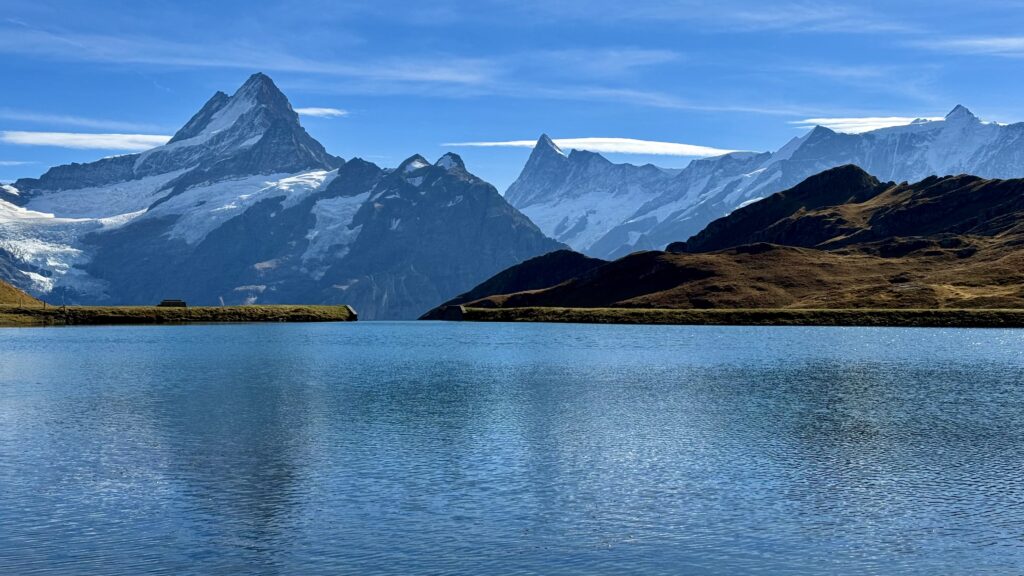
From the rotating restaurant of Piz Gloria where James Bond once filmed, to the 72 waterfalls of Lauterbrunnen valley, and the highest railway station in all of Europe at Jungfraujoch, this region of Switzerland feels almost unreal. With its wooden chalets, cattle bells echoing across green meadows, and trains that arrive on the second, this is a place that lives up to every postcard you have ever seen of the Alps.
Welcome everyone to the Bernese Oberland of Switzerland, where the mountains never stop watching over you.
For Complete Swiss Travel Guide
Things to Do in Interlaken – 5 Day Itinerary in Switzerland
Day 1 – Arrival in Interlaken and First Glimpse of the Alps
Zurich Airport to Interlaken Ost – The Lucerne Interlaken Express
We landed at Zurich airport in the morning. From the airport train station, which is right below the arrival terminal, we boarded a Swiss Federal Railways train towards Lucerne. The journey from Zurich to Lucerne takes just under an hour. At Lucerne we changed trains and boarded what is honestly one of the most scenic train rides in all of Europe, the Lucerne Interlaken Express.
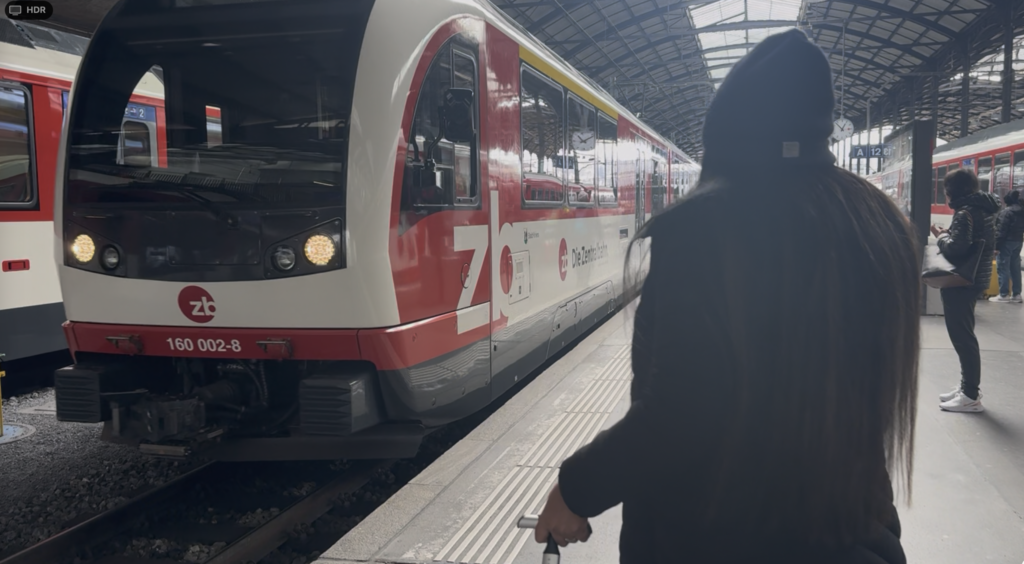
This panorama train has specially designed coaches with extra large windows, so you do not miss a single mountain or lake along the way. The journey crosses five lakes, countless tiny villages with red roofs, and several mountain ranges in two hours of pure visual joy. We almost forgot to eat the sandwiches we had packed because we could not take our eyes off the windows.
📌 Official Resource: Book Swiss train tickets, panorama train seats and check live timetables on the official Swiss Federal Railways site. Visit Official Website
Why Interlaken Has Two Train Stations
Interlaken has two main railway stations, Interlaken West and Interlaken Ost. Interlaken Ost is the gateway to almost every famous viewpoint in the region. We strongly recommend choosing your hotel close to Interlaken Ost so that every day you can simply walk to the station and hop on the next train. We saved hours of bus rides this way.
The town itself is small, walkable, and has a relaxed alpine vibe. Within ten minutes of leaving the station you can be standing in the middle of a green meadow called Hohematte where paragliders land throughout the day. We just sat there for a while, watching colourful parachutes drop out of the sky, and that was our welcome to Interlaken.
Interlaken Tourist Spots
Evening Walk to Harder Kulm – Top of Interlaken
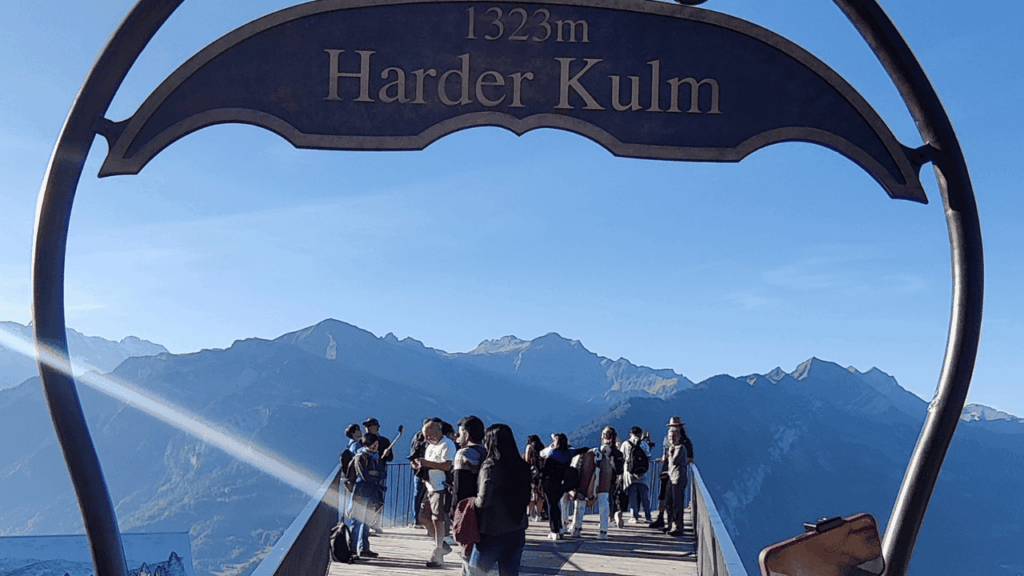
For our first evening we kept it simple and went to Harder Kulm, the local mountain that overlooks all of Interlaken. The Harder Bahn funicular station is just a five minute walk from Interlaken Ost station. The funicular climbs steeply through the forest and reaches the top in about ten minutes.
From Harder Kulm you can see both lakes that gave Interlaken its name, with the Eiger, Monch and Jungfrau lined up perfectly in the distance. There is a Two Lakes Bridge platform that juts out from the cliff and gives you the best photograph of the trip. Sunset from up here is unforgettable. We spent close to two hours just sitting on a bench, drinking coffee from the mountain restaurant, watching the lakes turn orange and pink.
Time needed: 2 to 3 hours including the funicular ride both ways.
📌 Official Resource: Jungfrau Railways operates Harder Kulm, Jungfraujoch and several other mountain excursions. Book online to skip queues. Visit Official Website
Day 2 – Lauterbrunnen Valley and the Mannlichen Ridge
Lauterbrunnen – The Valley of 72 Waterfalls
The next morning we caught an early train from Interlaken Ost to Lauterbrunnen. The journey takes just 20 minutes, but here is something nobody tells you. The train splits into two halves at Zweilutschinen station. One half continues to Lauterbrunnen, the other goes to Grindelwald. If you sit in the wrong half, you will end up at the wrong destination. We jokingly call this the going to Chennai when you wanted Kochi mistake. Always check the digital sign on each coach before sitting down.
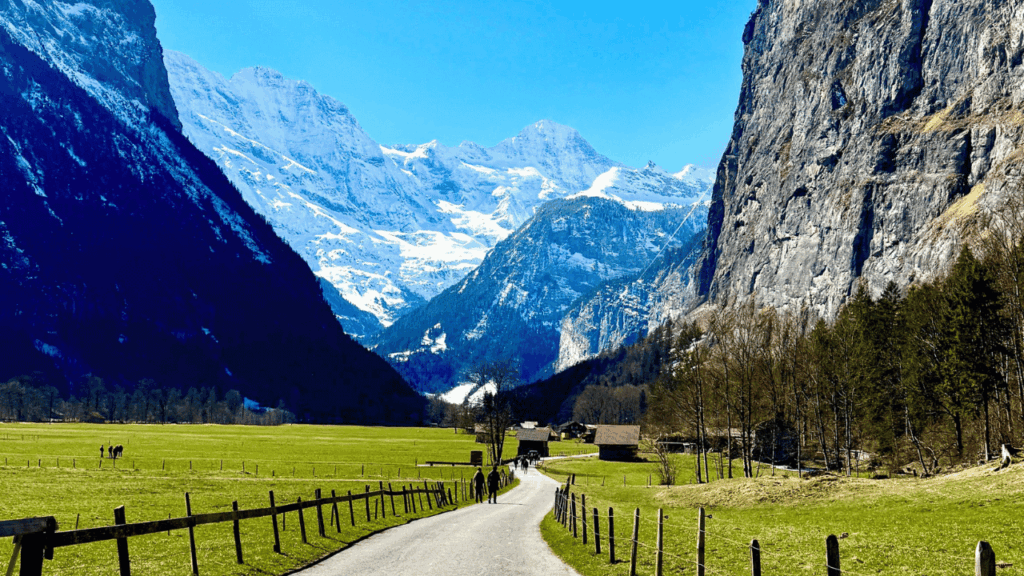
Lauterbrunnen is famously called the Valley of 72 Waterfalls and the moment you step off the train you understand why. Vertical cliffs rise on both sides of the valley, and water cascades down from the top in dozens of streams. The most iconic of all is Staubbach Falls, which drops nearly 300 metres in a single fall, right next to the village. There is a free walking path to the base of Staubbach, and during summer you can even walk behind the waterfall.
Time needed: 2 hours minimum to walk through the village and see Staubbach.
From Lauterbrunnen to Wengen – The Cliffside Train
From Lauterbrunnen we took the BLM mountain train up to Wengen. Wengen is a car free village built on a green ledge halfway up the mountain, with no road access from below. Only the train can take you there. The ride itself climbs steeply and gives you a bird’s eye view of Lauterbrunnen valley below. Wengen has wooden chalets, cowbells, and an unmistakable Heidi storybook charm.
Wengen to Mannlichen – The Royal Walk
From Wengen there is a direct cable car to Mannlichen, a hill point that gives you a different angle on the Alps than Harder Kulm. The view from up here is panoramic, with the Lauterbrunnen valley stretching below and the Eiger massif rising in front of you. There is a famous walking path here called the Royal Walk that leads to a small viewpoint at the very top of the ridge.
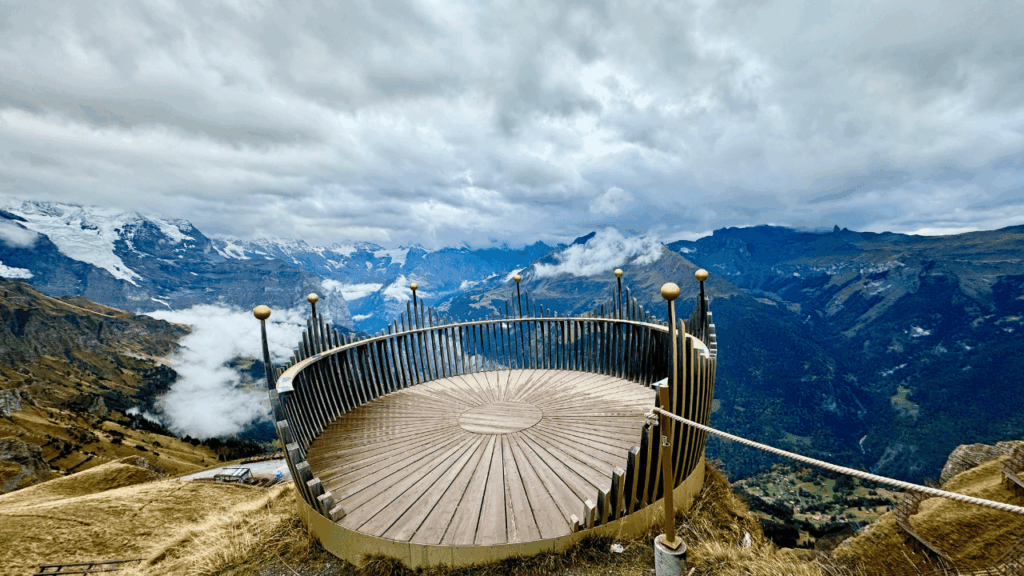
It looks short when you start, but it is a steep walk. We thought we were almost at the top within five minutes, but the trail just kept going. Wear proper walking shoes, carry water, and take your time. The reward is a 360 degree view that makes every step worth it.
Time needed: Full day. Allow 7 to 8 hours from Interlaken and back.
Day 3 – Schilthorn, Murren and the James Bond Mountain
Stechelberg to Gimmelwald – The World’s Steepest Cable Car
Day three was reserved for what turned out to be our favourite day of the entire trip, the journey up to Schilthorn. From Interlaken Ost we took the train to Lauterbrunnen, then a short bus to Stechelberg. From Stechelberg you board a brand new aerial cable car that climbs up to Murren. This new section, opened recently, has a gradient of 159.4 percent, which makes it the steepest cable car in the world.
The cable car has two stops on the way, the first at Gimmelwald, then continuing to Murren. We strongly recommend stopping at Gimmelwald even if just for an hour. Most tourists fly straight past it. Gimmelwald is a tiny mountain village with cattle farms, wooden chalets, and almost zero tourist crowd. The locals leave a farm fridge by the side of the path, with fresh cheese, milk and yoghurt. You drop the money in a small wooden box and take what you want. It is an old fashioned trust system that we Indians could honestly learn a lot from.
Walking from Gimmelwald to Murren – The Best Trail in the Region
Instead of taking the cable car directly to Murren, we walked. The trail from Gimmelwald to Murren takes about 45 minutes and is honestly one of the most beautiful walks we have ever done. It is a gentle climb on a well maintained path, with wildflowers, grazing cows, and views of Eiger, Monch and Jungfrau on your right the entire time. If you are even moderately able to walk, do not miss this section.
What Makes the Schilthorn Cable Car Special
From Murren the cable car continues up through Birg, where there is a glass floored Skyline Walk and a 200 metre rocky cliff walkway called the Thrill Walk. We stopped at Birg for about 30 minutes. The Thrill Walk has glass panels you can stand on, looking straight down hundreds of metres into the rock below. If you are afraid of heights, just hold the rail and breathe.
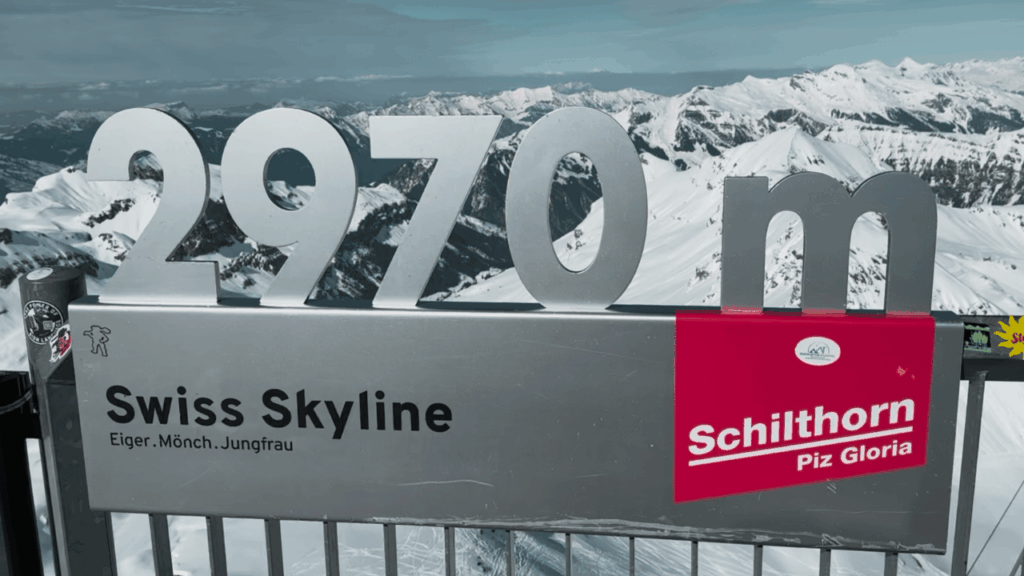
From Birg the final cable car climbs to the summit of Schilthorn at 2,970 metres. The journey from Stechelberg to the top takes about 30 minutes including all the changes. Cable cars run every 30 minutes from 7:55 AM, with the last downhill journey at 4:55 PM. Always check the latest timetable before going.
Why Schilthorn is Famous – The James Bond Connection
At the top of Schilthorn sits Piz Gloria, a revolving restaurant that completes a full rotation while you eat. The restaurant gets its name from the 1969 James Bond film “On Her Majesty’s Secret Service”, in which it served as the mountain hideout of villain Blofeld. The film crew financed part of the construction of the building in exchange for exclusive filming rights. Today the lower floor houses a James Bond exhibition called Spy World, with original props, an interactive cinema, and even a bobsleigh ride simulator.
The view from Piz Gloria is unbelievable. You can see over 200 alpine peaks including the famous trio of Eiger, Monch and Jungfrau. We had the Schilthorn brunch, which is served daily until 2 PM, and watching the entire Bernese Alps slowly rotate past your window over an hour is something you do not forget.
Time needed: Full day. Allow at least 7 to 8 hours including travel and a leisurely lunch.
📌 Official Resource: Schilthorn Cableway runs the Stechelberg, Murren and Schilthorn cable cars. Book tickets, check timetables and view live webcams on their official site. Visit Official Website
Day 4 – Jungfraujoch, the Top of Europe
Grindelwald Terminal and the Eiger Express Cable Car
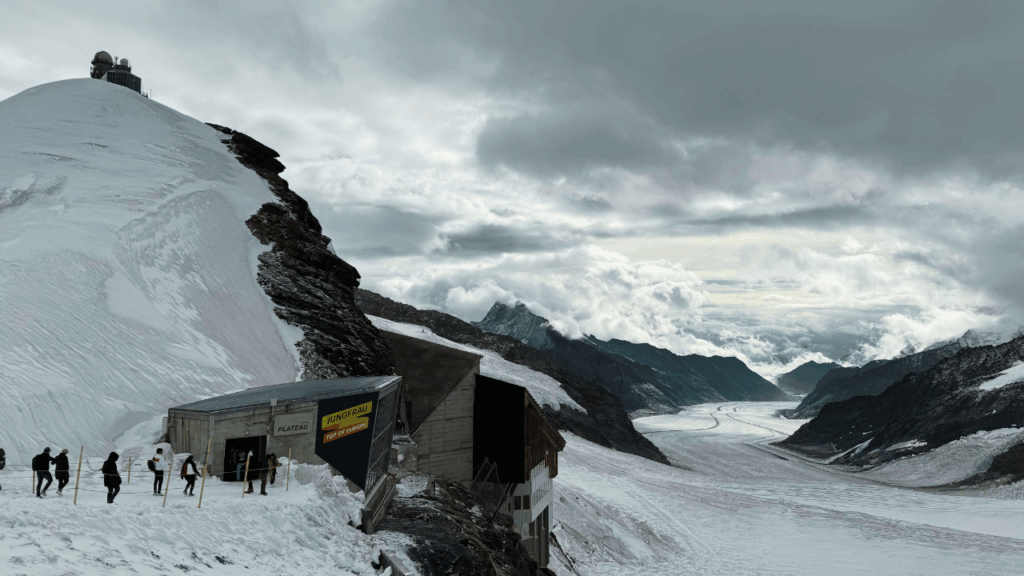
Day four is the day every Switzerland traveller looks forward to, the journey to Jungfraujoch, the highest railway station in all of Europe at 3,454 metres. From Interlaken Ost we took the train to Grindelwald Terminal, a modern cable car station built specifically for this excursion. From there we boarded the Eiger Express, a tri cable gondola that opened in December 2020.
The Eiger Express ride is breathtaking. The gondola passes right under the famous North Face of the Eiger, one of the most legendary climbing walls in the world. In 15 minutes you reach Eigergletscher station. From here you transfer to the Jungfrau Railway, which carries you through a tunnel cut into the rock for the final 50 minutes up to Jungfraujoch.
What Makes Jungfraujoch Top of Europe Special
The mountain railway that leads to Jungfraujoch took 16 years to complete because of the difficult alpine terrain. It has been running for more than a century. At the top there is snow all year round, even in July and August. Once you arrive, there is enough to do for at least three hours.
- The Sphinx Observation Deck offers a 360 degree view at 3,571 metres altitude.
- The Ice Palace is a tunnel carved entirely inside the glacier, with ice sculptures along the walls.
- The Lindt Swiss Chocolate Heaven has a small chocolate experience and free samples.
- The Snow Fun Park outside lets you sled, zip line and play in fresh snow.
- The Aletsch Glacier viewpoint shows you the largest glacier in the Alps stretching 22 kilometres into the distance.
Honestly we were not prepared for how cold it was up there. Even in April it was minus six degrees with strong winds. Carry a proper jacket, warm socks, gloves and sunglasses. The sun reflects very strongly off the snow and can hurt your eyes within minutes.
Time needed: Full day. Allow 8 to 10 hours including travel time both ways.
How Much Does Jungfraujoch Cost in 2026
Jungfraujoch is the most expensive single excursion in the Bernese Oberland. The full return ticket from Interlaken costs around CHF 249, which is roughly 24,000 Indian rupees. With the Berner Oberland Pass you save about 25 percent on the section from Grindelwald or Wengen up to the summit. With the Jungfrau Travel Pass the supplement comes down to CHF 89 in summer (June to August) and CHF 63 in the rest of the year. Book early, especially between May and August, when seat reservations are mandatory.
📌 Official Resource: Book Jungfraujoch tickets, Eiger Express tickets and check seat availability on the official Jungfrau Railways site. Visit Official Website
Day 5 – Grindelwald First and the Cliff Walk
Why Grindelwald is the Heart of the Region
For the final day we kept things lighter and headed to Grindelwald, a charming alpine town with a relaxed weekend vibe. From Interlaken Ost the train takes about 35 minutes. Grindelwald itself is worth slowing down for. There are wooden chalets covered in flower boxes, mountain bakeries, small souvenir shops, and excellent walking paths radiating out in every direction.
Grindelwald First – The Adventure Peak
From the centre of Grindelwald village a cable car climbs up to a peak called Grindelwald First. The ride takes about 25 minutes and rises through pine forests and alpine meadows. At the top there is a beautiful turquoise mountain lake called Bachalpsee, which is a 90 minute walk from the cable car station, and absolutely worth the effort.
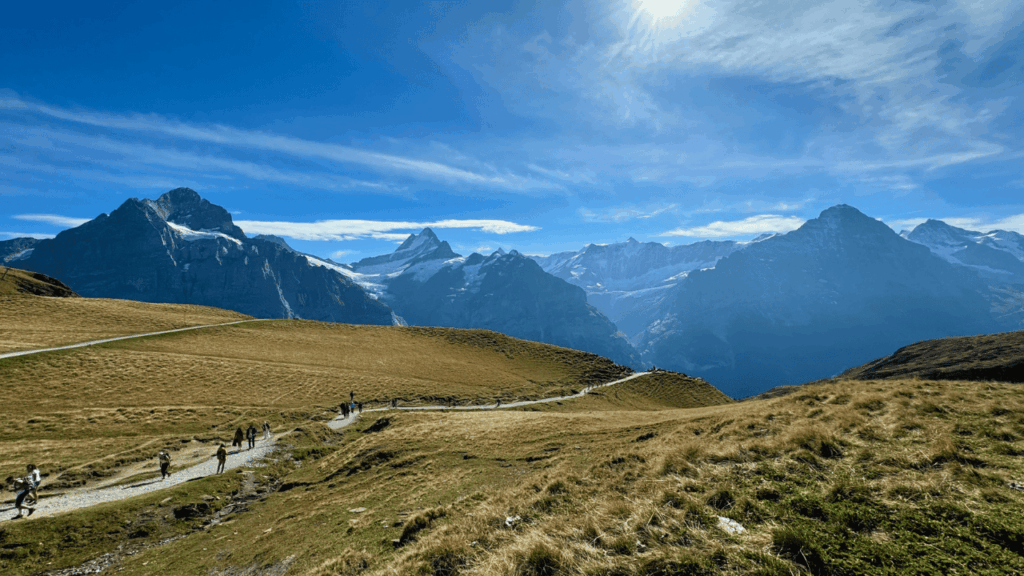
The most unique attraction here is the First Cliff Walk by Tissot, a metal walkway built right into the side of the cliff wall. There is a section where you walk on a transparent platform that juts out into thin air, with nothing between you and the valley floor far below. We were nervous at first but ended up walking it three times. The view of the Eiger from the cliff platform is genuinely something else.
If you are travelling with adventure lovers, Grindelwald First also offers a mountain cart, a trottibike scooter, and a zip line down to the lower stations. We did not try them this time, but our friends who came in summer raved about the mountain cart.
Time needed: 5 to 6 hours including the cable car ride and lake walk.
Evening – Goodbye to the Bernese Oberland
We came back to Interlaken in the early evening, picked up some Swiss chocolates and a few Lauterbrunnen postcards as gifts, and walked one last time along the Aare river. The water in the Aare runs an unreal turquoise colour because it comes straight from the glaciers. Sitting on the riverside, watching the last sun catch the snow on the Jungfrau, we already knew we would come back.
Where to Stay in Interlaken?
Interlaken West is ideal for restaurants and relaxed evening walks, while Interlaken Ost has stronger rail links. Interlaken Ost is where the main railway station is located, making it the better choice if you want to explore the broader region by train. These two are the best options for accomodation in Interlaken.
How to Reach Interlaken – Travel Options
Train – The Most Recommended Option
From Zurich airport, take a Swiss Federal Railways train to Lucerne (about 1 hour), then change to the Lucerne Interlaken Express to Interlaken Ost (just under 2 hours). The total journey is around 3 hours and is one of the most scenic train rides in Europe. From Geneva airport, the route via Bern takes around 3 hours.
Trains run almost every hour, all year round, with WiFi, restrooms, food trolleys and panorama windows on the express service.
To Book Tickets:
- Swiss Federal Railways: sbb.ch/en
- Switzerland Travel Centre: switzerlandtravelcentre.com
- Trainline: thetrainline.com
Flight – The Fastest Option
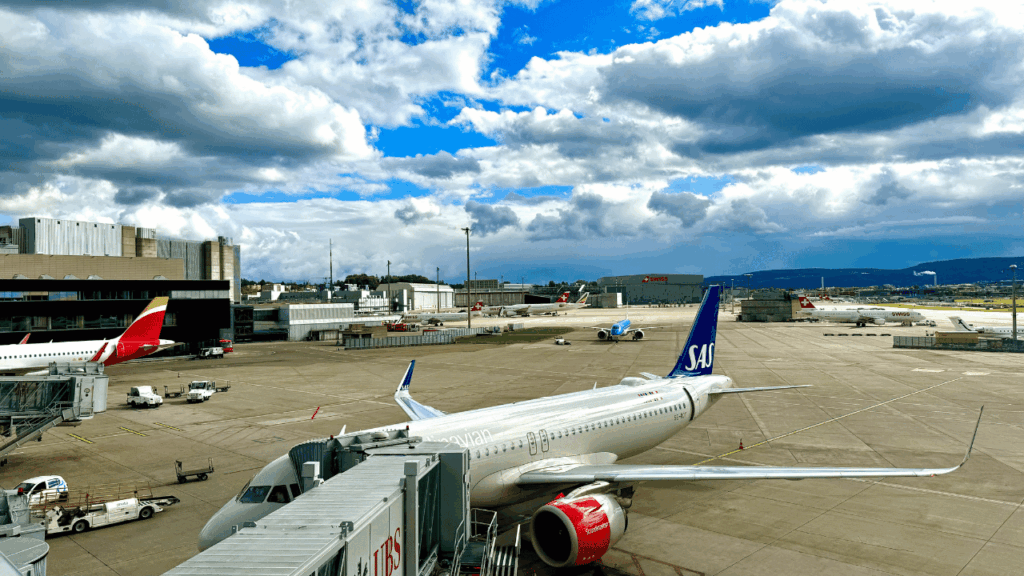
The nearest international airports are Zurich (ZRH) and Geneva (GVA). Both have excellent direct rail connections to Interlaken from inside the airport. Bern airport is closer but has very limited international flights. Most travellers from India, the Gulf and other parts of Europe will fly into Zurich.
Bus – The Budget Option
FlixBus and similar long distance bus companies operate from major European cities like Milan, Munich, Paris and Frankfurt to Interlaken. It is significantly cheaper than the train but takes much longer.
Private Car
Driving from Zurich takes about 2 hours via the A8 motorway. Switzerland requires a vignette (highway sticker) which costs around CHF 40 per year and can be bought at the border. Parking inside Interlaken is limited and expensive, so most hotels charge an extra fee for guest parking.
Best Months to Visit Interlaken
| Month | Weather | Crowds | Best For |
|---|---|---|---|
| January to February | Snow, cold | Medium (ski crowd) | Skiing and winter views |
| March to April | Cool, melting snow | Low | Quiet travel and budget |
| May to June | Mild, blooming valleys | Medium | Most ideal balance |
| July to August | Warm and sunny | Highest | Hiking and water sports |
| September | Mild and clear | Medium | Photography and clear views |
| October | Crisp, autumn colours | Low | Foliage and quiet trails |
| November to December | Cold, early snow | Low (until ski season) | Christmas markets |
One important tip – mountain weather changes within hours in this region. Always check the official Swiss weather service before heading up to any peak. We use the MeteoSwiss app on our phone every morning during the trip.
📌 Official Resource: MeteoSwiss is the official Swiss weather service and provides accurate mountain forecasts that change regularly throughout the day. Visit Official Website
Which Travel Pass is Best for a 5 Day Interlaken Trip in 2026?
This is where smart planning saves you serious money. We used the Berner Oberland Pass for this trip. As of 2026, the 4 day pass costs CHF 270 and the 6 day pass costs CHF 320 in second class. The pass covers free unlimited travel on most trains, buses and boats in the Bernese Oberland region, plus full coverage of more than 25 mountain railways including Schilthorn, Mannlichen and Schynige Platte. Harder Kulm and Grindelwald First are 50 percent off, and Jungfraujoch gets a 25 percent discount on the final leg from Grindelwald or Wengen.
If you are visiting only the Jungfrau region and Jungfraujoch is your priority, consider the Jungfrau Travel Pass instead, since the supplement to the summit is much smaller. If you are doing a wider Switzerland trip including Zurich, Lucerne, Bern, Zermatt and Geneva, the Swiss Travel Pass works out cheaper.
📌 Official Resource: Berner Oberland Pass official site has the latest 2026 inclusions, prices and discounts for the Interlaken region. Visit Official Website
📌 Official Resource: Switzerland Tourism is the official national tourism portal with verified information on visa, passes, weather and routes. Visit Official Website
Things to Do in Interlaken – Quick Reference
| Attraction | Type | Cost (Approx) | Time Needed |
|---|---|---|---|
| Harder Kulm and Two Lakes Bridge | Funicular and Viewpoint | CHF 38 return | 2 to 3 hours |
| Lauterbrunnen Valley | Village and Waterfalls | Free (train extra) | 2 to 3 hours |
| Mannlichen Royal Walk | Cable Car and Trail | CHF 96 round trip | 5 to 6 hours |
| Schilthorn and Piz Gloria | Cable Car and Restaurant | CHF 108 from Stechelberg | 5 to 7 hours |
| Birg Thrill Walk | Cliff Walkway | Free with Schilthorn ticket | 30 to 45 minutes |
| Jungfraujoch Top of Europe | Highest Railway in Europe | CHF 249 from Interlaken | Full day |
| Grindelwald First Cliff Walk | Cable Car and Glass Walk | CHF 76 round trip | 5 to 6 hours |
| Lucerne Interlaken Express | Panorama Train | CHF 64 one way (free with passes) | 2 hours |
| Bachalpsee Lake Walk | Hiking | Free | 2 to 3 hours |
| Aare Riverside Walk | Town Walk | Free | 1 hour |
Interlaken – A Region That Calls You Back
Switzerland has many beautiful corners, but the Bernese Oberland feels like the soul of the country. Five days here is enough to see the highlights, but never enough to fully understand it. Every viewpoint reveals a new shade of green, every cable car ride opens a new valley, and every cup of coffee comes with a postcard view that locals seem to take for granted.
We did this entire trip without any travel agent, no expensive tour package, and no rushed group itinerary. We researched the routes, picked our pass, booked our trains and chose our hotel ourselves. If you take the time to plan it properly, Switzerland rewards you back tenfold for every hour you spent preparing.
Journeys and sights never really end. They continue on and on. We will return again with memories of another journey.
Frequently Asked Questions
Is 5 days enough for Interlaken and the Bernese Oberland?
Yes, five days is the perfect length for Interlaken if you base yourself in town and do day trips. You can comfortably cover Harder Kulm, Lauterbrunnen, Mannlichen, Schilthorn, Jungfraujoch and Grindelwald First in this time without rushing.
How do I travel from Zurich airport to Interlaken?
The most comfortable option is the train. From Zurich airport take a direct Swiss Federal Railways train to Lucerne, then transfer to the Lucerne Interlaken Express. The total journey takes about 3 hours and is itself one of the highlights of the trip.
What is the difference between Schilthorn and Jungfraujoch?
Schilthorn is famous for its James Bond connection and the rotating restaurant Piz Gloria, with sweeping views of 200 alpine peaks. Jungfraujoch is the highest railway station in Europe with year round snow, an ice palace and the Aletsch glacier viewpoint.
Do I need to book Jungfraujoch tickets in advance?
Yes, especially between May and August when seat reservations are mandatory. Even outside this window, advance booking secures your time slot and avoids long queues at Eigergletscher station.
Can the entire Interlaken region be explored on foot?
Not entirely, since the peaks need cable cars and trains, but every village and viewpoint has beautiful trekking paths between them. The walk from Gimmelwald to Murren is one of the best in the region.
Is Interlaken expensive compared to other European destinations?
Yes, Switzerland is one of the most expensive countries in Europe. A regular meal costs around CHF 25 to 40 per person, and mountain excursions add up quickly. Buying a multi day pass and shopping for groceries at Coop or Migros saves a lot.
Found this helpful? Share it with someone planning a Switzerland trip. Subscribe to our YathraJalakam YouTube channel for honest travel videos and follow us on Instagram for daily updates: @yathra_jalakam.