Spanish Driving License for Indians 2026: Full Step-by-Step Guide
If you are an Indian living in Spain or planning to move here, getting your Spanish driving license for Indians is one of those tasks that trips up almost everyone in the beginning. Unlike citizens of many other countries, Indians cannot simply convert their existing license into a Spanish one – you have to go through the full process from scratch. This guide covers everything you need to know so you don’t waste time or money figuring it out on your own.
The good news is that the process is completely doable without any agent or consultant. It takes preparation, a little patience, and the right information – which is exactly what we are sharing here.
▶️ Watch Full Video👇
Can Indians Convert Their Indian Driving License in Spain?
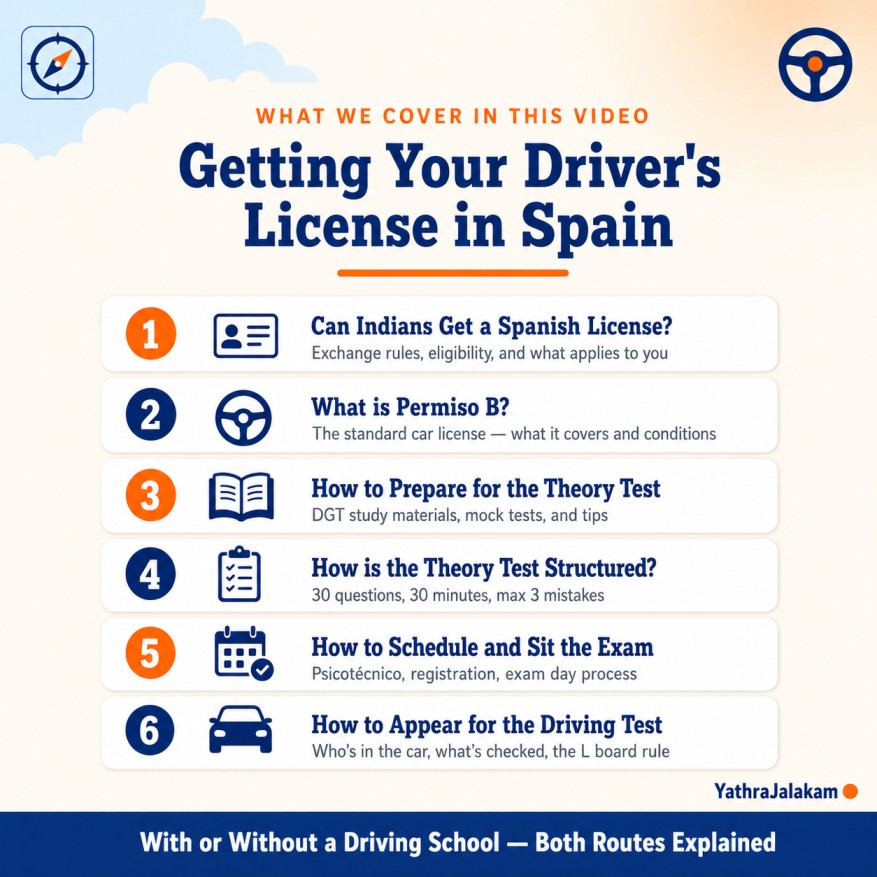
Unfortunately, no. Spain has bilateral agreements with several countries that allow direct license conversion – meaning if you hold a license from one of those countries, you can swap it for a Spanish one without sitting any exam. India is not on that list. This catches a lot of newly arrived Indians off guard, especially those who have been driving for decades back home.
What this means in practice is that your Indian driving license and experience count for nothing officially in the Spanish system. You will need to pass both a theory test and a practical driving test to earn your Spanish license. There is no shortcut, and no agent can change this – it is Spanish law. We have seen friends spend money on consultants who promised to “handle the conversion” only to be told the same thing months later. Save yourself that trouble.
That said, when you first arrive in Spain, you are not completely stuck. For the first six months after arriving, you are legally allowed to drive using your Indian driving license along with an International Driving Permit (IDP). The IDP is simply a translated version of your license that foreign authorities can read – it is valid for tourists too. You can get the IDP from the Regional Transport Office (RTO) back in India before you travel. After those six months, you must have a Spanish license to drive legally.
What is the Permiso B and What Can You Drive With It?
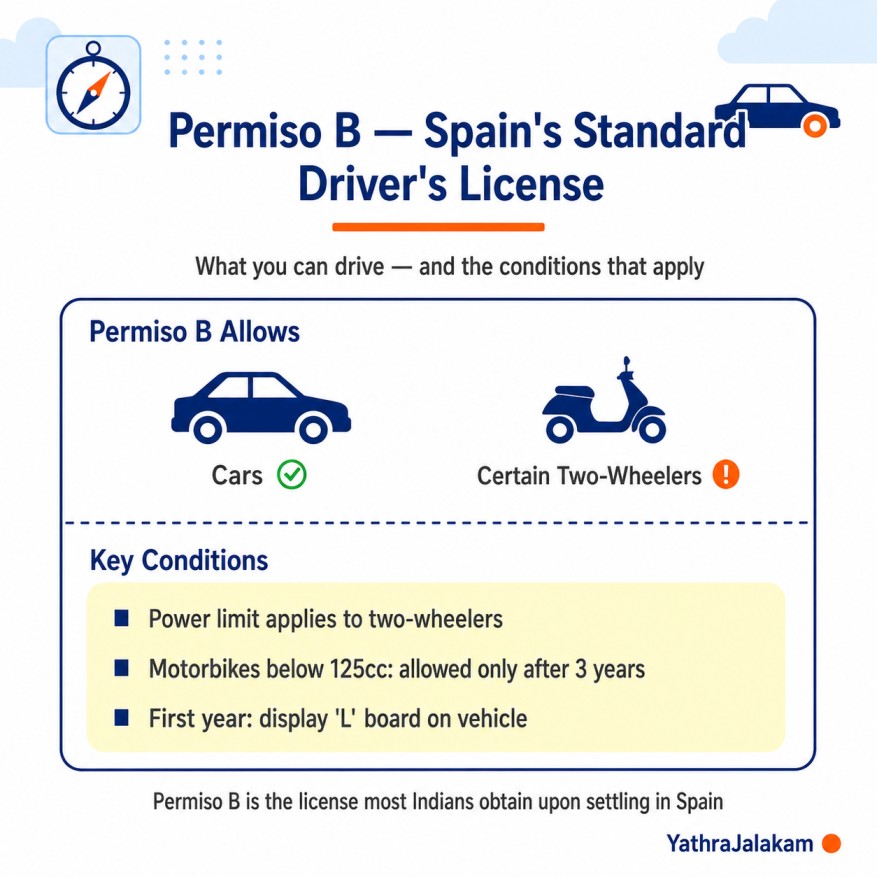
The standard driving license in Spain for cars is called Permiso B (Licence B). This is the one almost every Indian living here gets first, and it is the equivalent of a regular car driving license. With a Permiso B you can drive passenger cars, and also certain two-wheelers – but with conditions. For example, you can ride motorcycles under 125cc, but only after you have held the Permiso B for at least three years. There are also power restrictions that apply depending on the vehicle type.
If you eventually need to drive heavier vehicles or motorcycles of higher capacity, there are separate license categories (A1, A2, C, etc.), but for the vast majority of Indians moving to Spain for work or family life, Permiso B is the starting point and often the only one needed.
What Are the Two Ways to Get Your Spanish Driving License?
There are two main routes Indians take to get their Permiso B in Spain:
- Through a registered driving school (autoescuela) – The school handles your theory prep, practical training, test registration, and paperwork. This is the route most people take and the one we recommend for anyone new to Spain.
- Independently (libre) – You study on your own, register directly with the DGT for the theory exam, pass it, and then arrange the practical test yourself. This is legally allowed but significantly more complicated – especially the practical part. More on this below.
Most people who have done it both ways will tell you the same thing: the driving school route is easier and more reliable, even if it costs more. The independent route suits people who are already very confident drivers and are willing to do a lot of extra legwork for the practical test.
Step-by-Step: How to Get Your Spanish Driving License Through a Driving School
Step 1: Choose the Right Driving School
Not all driving schools in Spain are the same, and this is where Indians need to be especially careful. The majority of autoescuelas operate primarily in Spanish – their classes, materials, and instructors will all be in Spanish. If your Spanish is not yet strong enough to follow technical traffic-law instruction, you need to find a school that explicitly offers English-language classes and materials. They do exist, particularly in larger cities like Madrid and Barcelona, but you need to ask directly before signing up.
There are also scams to watch out for. Some schools will quote you a low headline price and then charge separately for study materials, exam registration, re-sits, and practical lessons – with everything adding up to much more than what was initially quoted. Always ask for a full breakdown of costs before signing anything. If they are vague about pricing, walk away. Spanish driving license requirements and common traps are also covered in our wider Spain FAQ which is worth reading alongside this guide.
Fee structures at driving schools vary quite a bit. Some schools charge everything upfront as a package. Others break it into stages – one payment when you buy study materials, another when you register for the theory exam, and another before the practical test. Neither approach is inherently better, but make sure you fully understand what you are agreeing to. Our cost of living guide for Spain can help you budget for this alongside your other expenses.
Step 2: Get the Psicotécnico (Medical Certificate)
Before you can register for the theory exam, you need to get a Psicotécnico certificate from an authorised medical centre. This is a basic psychophysical test that checks your reaction time, hand-eye coordination, peripheral vision, and general fitness to drive. The whole thing takes around five minutes and is not something you can fail unless you have a serious underlying medical condition. There are authorised Psicotécnico centres (centros de reconocimiento de conductores) in every city – just search for one near you, walk in with your ID, pay the fee, and you are done. The certificate is typically valid for a limited period so time it reasonably close to your exam registration.
Step 3: Prepare for and Pass the Theory Test (Examen Teórico)
The Spanish theory test is noticeably harder than what most Indians experienced back home. It is not just a matter of memorising traffic signs and rules – the questions are largely scenario-based, meaning you are shown a road situation and must apply the correct rule to decide what a driver should do. A lot of the questions rely on understanding priority rules at intersections, speed limits in different road types, and correct behaviour in emergency or unusual situations. Simply memorising a list of rules is not enough.
The exam itself is 30 questions in 30 minutes. You are allowed a maximum of 3 mistakes. If you make 4 or more errors, you fail. The good news is the exam is available in English as well as Spanish, so language is not a barrier for the written test itself. Your driving school will schedule a time slot for you at the nearest DGT exam centre. Arrive at least 30 minutes before your slot – the centres can be busy and you don’t want to be rushing.
Results are published the same evening, usually by around 5.30 to 6pm. You can check them directly on the DGT website using your NIE number, or ask your driving school. If you fail, you get one more attempt within the same six-month registration window at no extra exam fee.
📌 Official Resource: Check theory exam results, official study manuals, and register for tests on the DGT portal. Visit DGT Official Website
Step 4: Complete Practical Training and Book the Driving Test
Once you pass the theory test, the clock starts. You must complete and pass your practical driving test within two years of passing the theory – otherwise the theory result expires and you have to start everything again from scratch. Use this window wisely.
Your driving school will provide a dual-control car for your lessons and for the actual exam. This is important – the practical test is legally required to be conducted in a car with dual controls (one set for the driver, one for the instructor). This is why doing the practical test independently is so difficult: you would need to source a dual-control vehicle yourself, which is almost impossible for a private individual.
The examiner who sits in your car during the test will ask you a few basic questions in Spanish before you start driving. These are usually very simple things like identifying a warning light on the dashboard or explaining a basic procedure. Your driving instructor will prep you for these during your lessons – it is not something you need to stress about, but knowing a few basic Spanish automotive phrases helps. If you want to build your confidence with Spanish in parallel, our guide on how long it takes Indians to learn Spanish is a useful read.
During the test, your driving, road observation, mirror use, speed management, parking, and behaviour at junctions will all be assessed. The examiner marks everything on a standard form. If you pass, your license is issued. If not, you can repeat the practical test – but additional attempts may incur extra fees with the driving school.
Step 5: The L Plate Period After Getting Your License
Once you hold your new Permiso B, you are not completely unrestricted just yet. For the first year after getting your license, you are required to display an L plate (L de Learner) on your vehicle at all times when driving. There is also a lower blood alcohol limit that applies to you during this period (0.1 mg/l breath compared to 0.25 mg/l for experienced drivers), and your point deductions for offences are harsher. After one year, the L plate requirement drops away and you are treated as a fully licensed driver.
What Does It Cost to Get a Spanish Driving License in 2026?
The total cost has two components: the government (DGT) fees and the driving school fees. These are separate and both are unavoidable if you go through a school.
| Item | EUR Cost | Approx. INR Value |
|---|---|---|
| Psicotécnico (medical test) | €35 – €45 | approx. ₹3,790 – ₹4,870 |
| DGT Theory Exam Fee | €12 – €15 | approx. ₹1,300 – ₹1,625 |
| DGT Practical Exam Fee | €95 – €110 | approx. ₹10,280 – ₹11,900 |
| Driving School Package: theory + practical lessons | €800 – €1,500 | approx. ₹86,560 – ₹1,62,300 |
| Study Materials, if purchased separately | €20 – €40 | approx. ₹2,165 – ₹4,330 |
| Total Estimated Cost | €950 – €1,700 | approx. ₹1,02,800 – ₹1,83,960 |
These figures are approximate for 2026. Driving school packages vary significantly depending on the city, the number of practical lessons included, and whether classes are in English. Madrid and Barcelona tend to be on the higher end. Always confirm the full fee in writing before enrolling. For broader context on monthly expenses in Spain, see what salary Indians need to live comfortably in Spain.
📌 Official Resource: DGT official exam fees and payment details can be verified directly on the Spanish traffic authority website. DGT Permiso B Official Page
Can You Get the License Without a Driving School?
Yes, it is legally possible – but with a significant catch for the practical side. Here is how the independent route works:
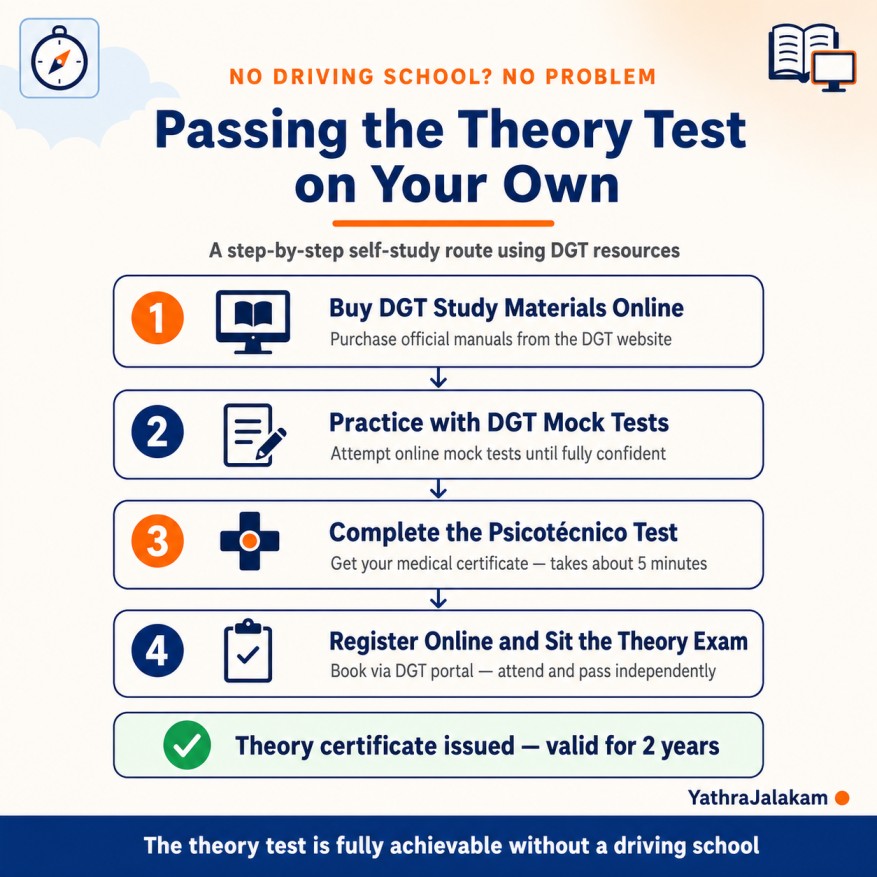
For the theory test, the process is actually quite straightforward. You purchase official DGT study manuals and access mock tests online (there are many free and paid platforms), study thoroughly, get your Psicotécnico certificate done, and then register directly on the DGT website for your theory exam slot. No school needed, no middle-man. This part is genuinely manageable for someone who is motivated and disciplined in their study approach.
The practical test is a different story. The exam must be conducted in a dual-control vehicle. Driving schools own these cars and provide them for their students. If you are not enrolled in a school, sourcing a dual-control car for the test is extremely difficult as a private individual – rental companies don’t offer them to the general public. So in practice, most people who go independent for the theory end up enrolling in a driving school just for the practical lessons and test. This hybrid approach – self-study for theory, school for practical – is actually a common and sensible way to reduce costs while still getting through the process reliably.
Quick Reference: Full Process Checklist
- Arrive in Spain with your Indian driving license and International Driving Permit (IDP) – valid for first 6 months
- Get your NIE (Foreigner Identification Number) if you don’t already have one
- Choose a driving school – confirm they offer English-language support if needed
- Get your Psicotécnico certificate from an authorised medical centre
- Complete theory classes (or self-study using DGT official materials)
- Register for and pass the DGT theory test (30 questions, max 3 mistakes)
- Complete practical driving lessons with a dual-control vehicle
- Pass the practical driving test with the DGT examiner
- Display the L plate for your first year of driving
📌 Official Resource: The official DGT app “MiDGT” lets you access your driving record, check exam dates, and receive digital notifications about your license process. Visit DGT Main Portal
Important Tips Indians Often Miss
A few things that don’t always come up in the standard guides but matter a lot in practice:
- Language at the driving test: The examiner will speak to you in Spanish during the practical test. Your instructor will prepare you for the standard phrases, but knowing even a few basic Spanish words for car parts and road instructions makes the experience much less stressful. If you are new to Spanish, our guide on whether you really need Spanish to live in Spain gives a realistic picture of how much you actually need day-to-day.
- Book your theory exam well in advance: DGT exam slots in popular cities like Madrid and Barcelona can fill up 4 to 6 weeks ahead. Don’t assume you can book a slot for next week.
- Don’t skip mock tests: The official DGT mock test platform (available on their website) uses real past-paper questions. Doing 20 to 30 of these before your exam is arguably more valuable than re-reading the manual a fifth time.
- Watch for driving school scams: If a school promiss guaranteed pass or charges unusually high fees upfront with no written contract, walk away. There are reliable, honest schools – ask other Indians in your city for reccomendations.
- Jobs and driving: If you are moving to Spain for work, some roles do require a Spanish driving license. Check what jobs Indians are getting in Spain in 2026 to see whether a license is relevant to your field.
Final Thoughts
Getting your Spanish driving license as an Indian is one of those things that feels overwhelming when you first look at it – multiple tests, Spanish paperwork, unfamiliar rules, and real money involved. But once you break it down step by step, it is entirely manageable.
Our honest Suggestion: start early, choose your driving school carefully (especially on the English-language question), take the mock tests seriously, and don’t let the six-month IDP window lull you into delaying.
If you have questions specific to your situation – city, language level, whether you need a license for your job in Spain – drop them in the comments below. We read everything and will do our best to help.
Frequently Asked Questions
Can I drive in Spain with only my Indian driving license?
Yes, but only for the first six months after arriving in Spain, and only if you also carry an International Driving Permit (IDP) alongside your Indian license. After six months, you must hold a valid Spanish driving license to drive legally.
Is the DGT theory test available in English?
Yes, the DGT theory exam is available in both English and Spanish. You can select your preferred language when registering for the exam slot, so language is not a barrier for the written test specifically.
How many times can I attempt the theory test if I fail?
Within the same six-month registration period, you are allowed one additional attempt after a failed theory test at no extra government exam fee. If you fail both attempts, you will need to re-register and pay again.
How long does the full process take from start to finish?
It depends on how quickly you prepare and how available exam slots are in your city. Realistically, most people complete the full process in 3 to 6 months. In busy cities, waiting times for practical test slots can add to the timeline.
What is the Psicotécnico test and is it hard to pass?
The Psicotécnico is a basic psychophysical medical test that checks your reaction time, coordination, and vision. It takes about five minutes and is not something a healthy person will fail. You do it at an authorised medical centre before registering for your theory exam.
Is there any way to transfer my Indian driving license to Spain without taking a test?
No. India does not have a bilateral driving license reciprocity agreement with Spain, which means direct conversion is not possible regardless of how many years you have been driving in India. The full theory and practical tests are mandatory for all Indian nationals.
Found this helpful? Share it with someone planning to move to Spain. Subscribe to our Life in Spain for Indians YouTube channel for real, honest videos about life in Spain – and follow us on Instagram for daily updates: Spain News for Indians.