
₹1.2 Lakh Salary in Spain (€1400): 2026 Cost Breakdown for Indians
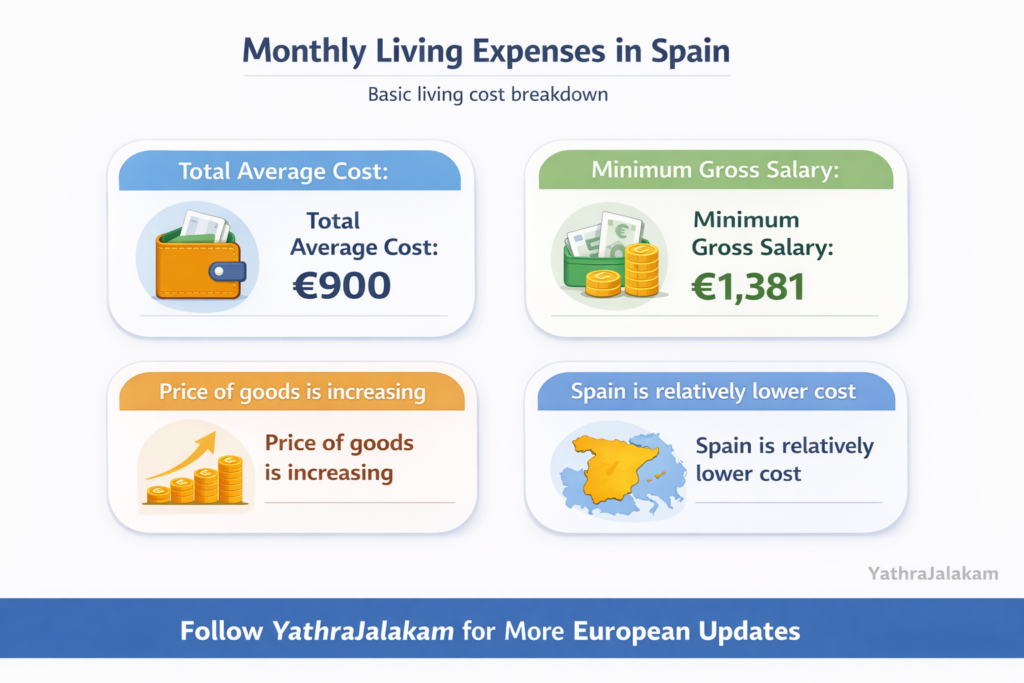
We moved to Spain several years ago from India and handled everything ourselves – job search, visa, apartment hunting, the whole thing. One question about the cost of living in Spain for Indians that we keep hearing from friends back home and people planning to move here is this: is a salary of 1,20,000 rupees per month (roughly €1,400 / ₹1,20,000) enough to live comfortably in Spain? Understanding what a Spain salary per month for Indian workers actually means in practice – after taxes, after rent, after groceries – is something nobody really explains until you are already here and the reality hits you.
Honestly, the answer is not as simple as yes or no. So we are going to break it down the way we wish someone had broken it down for us before we got on that flight.
What Does a 1,20,000 Rupee Salary Actually Mean in Spain?
When a company in Spain offers you a salary, they always mention the gross salary. This is the amount before any deductions. We figured this out ourselves when we first got our job offers here – the number they tell you is not what lands in your bank account every month.
A monthly salary of 1,20,000 Indian rupees converts to approximately 1400 euros at current exchange rates (though this fluctuates). But from this gross amount, two major mandatory deductions happen before you see a single euro in your account: social security contribution and income tax.
▶️ Watch Full Video
Social security covers your healthcare, pension fund, unemployment benefits, and other protections. You cannot opt out of this – it is compulsory for everyone working legally in Spain. Income tax works similarly to what we had back in India, calculated based on your earnings.
For someone earning 1400 euros gross per month, the social security deduction is approximately 6% and income tax is around 7%. These percentages change depending on whether you are single or married, whether you have dependents like children, and which autonomous region of Spain you live in. Our honest advice would be to always calculate your net salary before accepting any job offer.
Here is a quick breakdown so you can see exactly where your money goes before it reaches your account:
| Component | Percentage | Amount (EUR) | Amount (INR approx) |
|---|---|---|---|
| Gross Salary | 100% | €1,400 | ₹1,20,000 |
| Social Security Deduction | 6% | €84 | ₹7,200 |
| Income Tax (approx) | 7% | €98 | ₹8,400 |
| Net Take-Home Pay | ~89% | €1,218 – €1,250 | ₹1,04,000 – ₹1,06,000 |
📌 Official Resource: To calculate your exact net salary and tax deductions in Spain, use the official Spanish tax calculator. It is updated every year and helps you see exactly what will land in your account. Visit Official Website
After these deductions, your actual take-home pay from a 1400 euro gross salary would be approximately 1250 euros per month. That is roughly 1,06,000 to 1,08,000 rupees depending on the exchange rate. This is the amount you will actually use for rent, food, transport, and everything else.
Average Salary by Industry in Spain for Indians (2026)
Before we go further into whether €1,400 (₹1,20,000) is enough, you need to understand where this salary sits in the bigger picture. The average gross salary in Spain in 2026 is around €2,450 (₹2,10,000) per month. So if someone is offering you €1,400, they are offering you well below the national average. That is not necessarily a dealbreaker – entry-level roles and certain sectors do pay in this range – but you should know this going in.
Here is what Indians working in Spain are actually earning across different sectors in 2026. These are gross monthly figures before any deductions:
| Industry / Role | Gross Monthly (EUR) | Gross Monthly (INR approx) | Notes |
|---|---|---|---|
| IT / Software Engineering | €2,500 – €4,000 | ₹2,14,000 – ₹3,42,000 | Most common path for Indian professionals |
| Healthcare (Nurses, Doctors) | €2,000 – €3,500 | ₹1,71,000 – ₹3,00,000 | Spanish language required at B2+ level |
| Hospitality / Hotel Industry | €1,400 – €1,800 | ₹1,20,000 – ₹1,54,000 | Seasonal roles often at lower end |
| Teaching English (Language Schools) | €1,200 – €1,600 | ₹1,03,000 – ₹1,37,000 | Common entry route for new arrivals |
| Engineering (Non-IT) | €2,000 – €3,200 | ₹1,71,000 – ₹2,74,000 | Varies heavily by specialisation |
| Finance / Accounting | €1,800 – €2,800 | ₹1,54,000 – ₹2,40,000 | Big 4 firms pay at higher end |
| Spain National Average (all sectors) | €2,450 | ₹2,10,000 | For context: €1,400 is 43% below average |
The honest takeaway here is this: if you are in IT or a skilled profession and someone is offering you €1,400 (₹1,20,000) gross in Spain, push back. That number might be acceptable as a trainee or intern arrangement, but for an experienced professional, it is low. Use it only if the role gives you legal residency, a genuine career pathway, or experience in a European company that will open better doors within 12-18 months.
For finding IT jobs in Spain, we have a separate detailed breakdown of what companies are actually paying and how to evaluate offers.
How Much Does Rent Cost for Indians Living in Spain in 2026?
Rent is going to be your biggest monthly expense, and this is where many friends who came here without doing proper research faced the hardest shock. The cost varies hugely depending on two main factors: which city you choose and which neighborhood within that city.
People who moved to Madrid or Barcelona thinking €1,400 (₹1,20,000) gross would cover everything quickly discovered that rent alone can eat more than half their net take-home. Let us give you the real 2026 numbers.
In Madrid and Barcelona city centers, a one-bedroom apartment (what we call 1BHK back in India) costs €1,200 to €1,500 (₹1,03,000 – ₹1,28,000) per month or more. If you move outside the city center but still want decent connectivity to public transport, expect to pay €900 to €1,100 (₹77,000 – ₹94,000). These are the actual asking prices based on Numbeo and Idealista 2026 data – not the numbers from two or three years ago that some older articles still quote. And even these asking prices can sometimes be negotiated down by 5 to 10 percent if you present yourself well and are ready to commit to a longer lease.
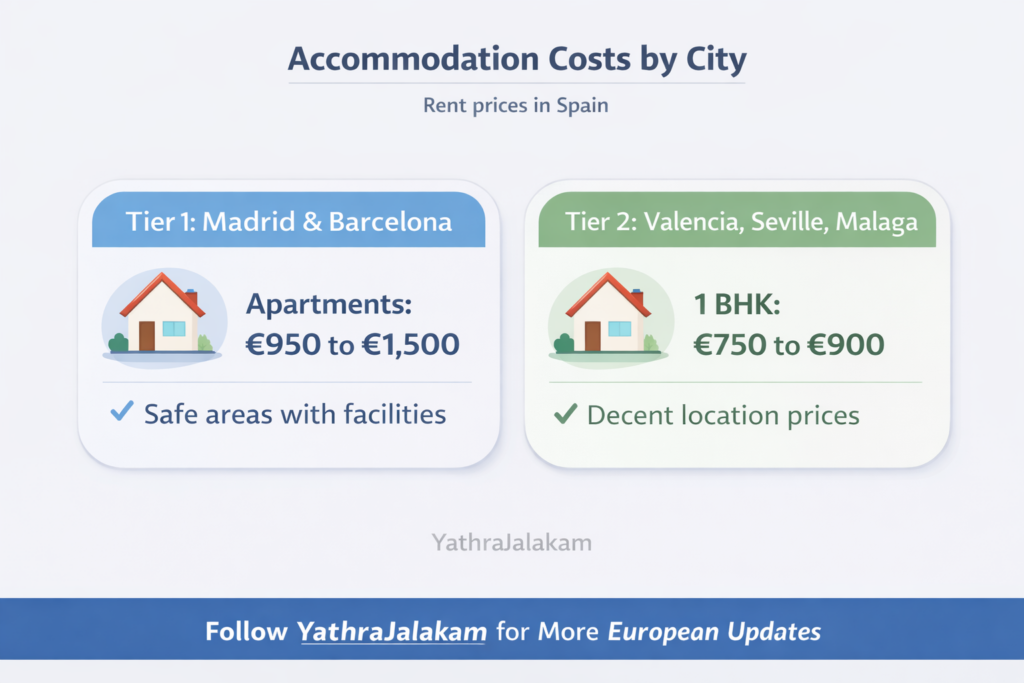
To be specific: Numbeo 2026 data shows the average 1BR city center apartment in Madrid at €1,298 (₹1,11,000) and in Barcelona at €1,450 (₹1,24,000). These are averages – which means you will find apartments above and below these numbers depending on the exact neighborhood and condition of the flat.
For a detailed cost of living breakdown including neighborhood comparisons, we have covered that separately.
Compare that to cities like Valencia, Seville, or other Andalusian cities. Friends who settled in Valencia pay around €850 to €1,000 (₹73,000 – ₹86,000) for a similar one-bedroom apartment in a good neighborhood with all amenities. That is roughly €300 to €400 (₹26,000 – ₹34,000) cheaper than Madrid every single month – which adds up to €3,600 to €4,800 (₹3,08,000 – ₹4,11,000) saved per year just on rent alone. The further you move from the city center, the cheaper the rent gets – but then your daily commute and transport costs go up.
Now, if you are coming alone and open to sharing an apartment with flatmates, the cost drops significantly – sometimes by half. Shared accommodation is very common among students and young professionals here. We found our apartment ourselves through local websites like Idealista and Fotocasa without using any agent.
Here is a city-wise rent summary for 2026:
| City | 1BR City Center (EUR) | 1BR City Center (INR) | 1BR Outside Center (EUR) | 1BR Outside Center (INR) |
|---|---|---|---|---|
| Madrid | €1,200 – €1,400 | ₹1,03,000 – ₹1,20,000 | €900 – €1,100 | ₹77,000 – ₹94,000 |
| Barcelona | €1,350 – €1,500 | ₹1,16,000 – ₹1,28,000 | €950 – €1,150 | ₹81,000 – ₹98,500 |
| Valencia | €850 – €1,000 | ₹73,000 – ₹86,000 | €650 – €800 | ₹55,700 – ₹68,500 |
| Seville | €750 – €900 | ₹64,200 – ₹77,100 | €550 – €700 | ₹47,100 – ₹59,900 |
| Shared Room (Madrid/BCN) | €400 – €600 | ₹34,200 – ₹51,400 | €300 – €450 | ₹25,700 – ₹38,500 |
Are There Cheap Apartments in Madrid and Barcelona?
Yes, there are apartments available at much lower rents even in Madrid and Barcelona. But be very careful. Some neighborhoods have a reputation for being unsafe, especially at night. People who came without doing their research faced issues with theft, noise, and safety. Locals generally avoid renting in these areas, which is why landlords offer big apartments at surprisingly low prices.
What Are the Monthly Utility Bills in Spain for an Indian Household?
After rent, your next major expense is utilities – electricity, water, heating (very important in winter), and gas if your apartment uses it for cooking or hot water. These are not included in rent unless your landlord specifically mentions it, which is rare.
Based on our experience and what friends around us pay, monthly utility costs for a one-bedroom apartment typically range from 130 euros to 200 euros. This can go higher in winter if you use a lot of heating, or in summer if you run air conditioning frequently. Compared to what we paid in India, the electricity cost here feels high – but the quality and reliability are much better.
On top of utilities, you need internet and a mobile SIM card. Internet (WiFi) costs around 30 to 40 euros per month for a decent speed connection. Mobile plans are cheaper than in many other European countries – you can get a good plan with sufficient data for about 10 to 20 euros per month. We use prepaid SIMs from providers like Orange, Vodafone, or Yoigo, and they work perfectly well.
- Electricity: 60 – 100 EUR per month
- Water: 20 – 35 EUR per month
- Heating (winter): 30 – 60 EUR per month
- Gas (if applicable): 15 – 25 EUR per month
- Internet: 30 – 40 EUR per month
- Mobile SIM: 10 – 20 EUR per month
So in total, you are looking at roughly 150 to 250 euros per month for utilities and connectivity. Add this to your rent, and you can see how quickly the expenses add up.
How Much Do Groceries and Food Cost in Spain Compared to India?
This is one area where people who came without knowledge struggled the most. You cannot simply convert Indian prices to euros and expect things to cost the same. A product that costs 20 rupees in India might cost 2 euros here, which is roughly 170 rupees – almost 8 times more. But salaries are also higher, so you have to think in terms of purchasing power, not direct conversion.
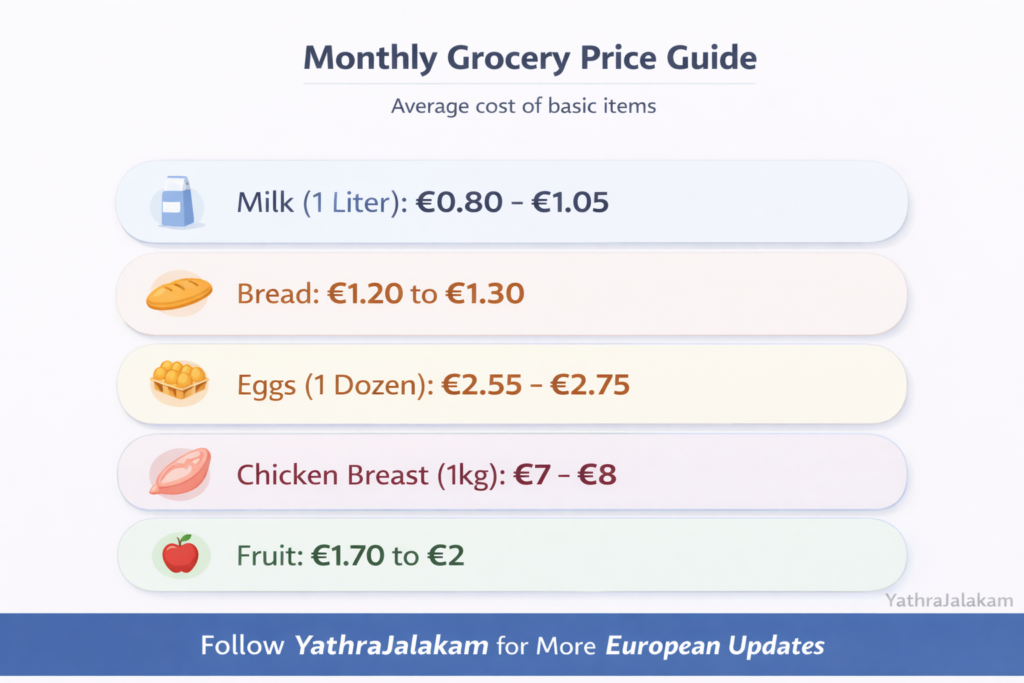
For example, we buy a standard pack of coffee here for around 1.50 euros, which is approximately 130 to 160 rupees. Back in India, the same quantity would cost maybe 30 to 40 rupees. Milk costs about 1 euro per liter (around 85 rupees), compared to 50-60 rupees in Indian cities like Bangalore or Mumbai. Vegetables and fruits are generally fresher here, but again, costlier than India.
If you cook at home most of the time, a single person can manage grocery expenses for around 150 to 250 euros per month. For a couple, it goes up to about 300 to 400 euros depending on your eating habits. If you prefer buying organic produce or specialty Indian ingredients, expect to pay even more. We handled this ourselves by shopping at supermarkets like Mercadona, Lidl, Mercado – they offer good quality at reasonable prices.
📌 Official Resource: The Spanish Ministry of Agriculture publishes average food prices every month. It helps you plan your grocery budget realistically. Visit Official Website
Spain Cost of Living vs India: Purchasing Power Comparison
One thing that confuses a lot of people planning to move from India is how to think about money in Spain. You cannot just convert rupees to euros and compare prices – because salaries are also completely different. The right way to think about it is purchasing power: what can your money actually buy you relative to your income?
Here is the picture based on Numbeo 2026 data, and it is quite striking:
| Cost Category | Spain vs India | What It Means |
|---|---|---|
| Overall Cost of Living | 193% higher in Spain | Living in Spain costs nearly 2x more than India |
| Rent Specifically | 496% higher in Spain | Rent is almost 5x more expensive than Indian metros |
| Groceries | ~150% higher in Spain | Food costs roughly 2.5x more than India |
| Restaurant / Eating Out | ~200% higher in Spain | A meal out costs about 3x what it would in India |
| Local Purchasing Power | ~40% higher in Spain | Your money goes further within the Spanish economy |
That last point is the one people miss. Yes, Spain is more expensive in absolute terms. But if you earn a Spanish salary, your local purchasing power is about 40% higher than an equivalent Indian salary in India. The problem with €1,400 (₹1,20,000) gross is that it is a below-average Spanish salary – so you are not even accessing that purchasing power advantage fully.
Here is a way to think about it practically: €1,250 (₹1,07,000) net per month in Spain is not equivalent to ₹1,07,000 in India. Based on PPP (Purchasing Power Parity) calculations, €1,250 in Spain gives you roughly the same purchasing power as ₹35,000 to ₹40,000 would in an Indian metro city like Bengaluru or Mumbai. That is the honest comparison.
This is why people who move to Spain expecting their Indian metro lifestyle – eating out frequently, ordering food delivery, buying clothes at will – end up shocked. Spain is a high-cost environment, and €1,400 gross is on the lower end of what that environment demands.
Quick India vs Spain price comparison for everyday items:
| Item | Spain Price (EUR) | Spain Price (INR) | India Price (INR) | Difference |
|---|---|---|---|---|
| 1 litre milk | €1.00 | ₹85 | ₹50-60 | ~60% higher |
| 500g rice (supermarket) | €0.80 | ₹68 | ₹25-30 | ~140% higher |
| Standard coffee pack | €1.50 | ₹128 | ₹35-40 | ~230% higher |
| Monthly rent 1BR center | €1,298 | ₹1,11,000 | ₹20,000-35,000 (metro) | 400-500% higher |
| Monthly metro pass | €60 | ₹5,130 | ₹600-1,200 | ~400% higher |
| Meal at local restaurant | €12-15 | ₹1,025-1,285 | ₹200-400 | ~300% higher |
| Mobile plan (monthly) | €15 | ₹1,285 | ₹200-300 | ~400% higher |
The one category where Spain is surprisingly comparable is healthcare – because if you are working legally, your social security contributions give you access to the public health system at no additional cost per visit. That is something genuinely valuable compared to paying out of pocket in India.
For more on how costs compare across different aspects of life, check our detailed cost of living breakdown.
Can You Find Indian Groceries Easily in Spain?
Yes, but it depends on the city. In Madrid, Barcelona, and Valencia, there are dedicated Indian and Asian grocery stores where you can find rice, lentils, spices, and even frozen Indian snacks. Prices are higher than in India, obviously, but its available. In smaller cities, you might have to order online or travel to a bigger city occasionally to stock up.
How Much Does Public Transport Cost in Spain for Daily Commute?
Public transport in Spain is excellent – punctual, clean, and well-connected, especially in cities like Madrid, Barcelona, and Valencia. Most people here, including us, rely on metro, buses, and trains for daily commuting rather than owning a car. It is much more economical and convenient.
A monthly public transport pass in Madrid or Barcelona costs around 55 to 70 euros depending on the zones you travel through. In smaller cities like Valencia or Seville, it is cheaper – around 40 to 50 euros per month. If you live close to your workplace and can walk or cycle, you save this entirely.
If you own a car, the costs shoot up dramatically – fuel, insurance, parking, maintenance, and road tax. For weekend trips, car-sharing services like BlaBlaCar or rented a car for a day or two, which worked out much cheaper.
- Monthly metro/bus pass (Madrid/Barcelona): 55 – 70 EUR
- Monthly metro/bus pass (Valencia/Seville): 40 – 50 EUR
- Single metro/bus ticket: 1.50 – 2.50 EUR
- Bicycle rental (monthly): 25 – 35 EUR
Is There Any Money Left for Savings on a 1,20,000 Rupee Salary in Spain?
Now let us do the math honestly. Your net take-home on a €1,400 (₹1,20,000) gross salary is approximately €1,250 (₹1,07,000) per month. The budget below is specifically for someone living in shared accommodation in Madrid or Barcelona – this is important. If you are planning to rent a one-bedroom apartment solo in either of these cities, scroll down to the solo living table because the numbers look very different.
Budget Scenario 1: Shared Accommodation in Madrid or Barcelona
| Expense | Monthly Cost (EUR) | Monthly Cost (INR approx) |
|---|---|---|
| Rent (shared apartment, your share) | €500 – €700 | ₹42,800 – ₹59,900 |
| Utilities and internet (shared, your share) | €60 – €80 | ₹5,100 – ₹6,800 |
| Groceries | €150 – €200 | ₹12,800 – ₹17,100 |
| Transport (monthly pass) | €55 – €70 | ₹4,700 – ₹5,990 |
| Mobile SIM | €15 | ₹1,285 |
| Miscellaneous (toiletries, etc) | €50 | ₹4,280 |
| Total Expenses | €830 – €1,115 | ₹71,000 – ₹95,400 |
| Remaining after expenses | €135 – €420 | ₹11,500 – ₹35,900 |
So on shared accommodation, you are left with roughly €135 to €420 (₹11,500 – ₹35,900) per month. That is your entire buffer for savings, emergencies, eating out occasionally, a weekend trip, clothes, or anything unexpected. It is tight. You will survive, but you will not feel comfortable.
Budget Scenario 2: Solo 1-Bedroom Apartment in Madrid or Barcelona (Reality Check)
| Expense | Monthly Cost (EUR) | Monthly Cost (INR approx) |
|---|---|---|
| Rent (1BR, outside center minimum) | €900 – €1,100 | ₹77,000 – ₹94,200 |
| Utilities and internet | €130 – €200 | ₹11,100 – ₹17,100 |
| Groceries | €150 – €200 | ₹12,800 – ₹17,100 |
| Transport (monthly pass) | €55 – €70 | ₹4,700 – ₹5,990 |
| Mobile SIM | €15 | ₹1,285 |
| Miscellaneous | €50 | ₹4,280 |
| Total Expenses | €1,300 – €1,635 | ₹1,11,300 – ₹1,40,000 |
| Remaining after expenses | €-385 to €-50 (deficit) | Running at a loss |
This is the uncomfortable truth that nobody wants to say out loud: on a €1,400 (₹1,20,000) gross salary, living alone in a one-bedroom apartment in Madrid or Barcelona is simply not financially feasible. You will run a deficit every month. Either you share accommodation, move to a cheaper city like Valencia or Seville, or negotiate a higher salary before accepting the offer.
To be fair, even the shared accommodation scenario is tight. You will need to budget carefully, cook at home most days, avoid expensive restaurants, and plan any travel during off-peak seasons. People who came through agents and did not plan their finances faced serious stress in the first few months.
If you have dependents – a spouse who is not working, or children – this salary will be very difficult to manage. We personally know couples where one partner had this kind of salary and they struggled significantly until the second person found work.
Minimum Salary Required for a Family of 2 to 4 in Spain
We get this question a lot from families planning to relocate together. The honest answer is that €1,400 (₹1,20,000) gross is simply not enough if you are coming as a family. Here is what you realistically need.
For a Couple (one person working):
You need a minimum net salary of around €2,000 (₹1,71,000) per month to cover rent, groceries, utilities, and transport without constant financial stress. And even at €2,000 net, you are not saving much – you are just covering the basics comfortably. This corresponds to a gross salary of roughly €2,300 to €2,500 (₹1,97,000 – ₹2,14,000).
For a Family of 3 or 4 (two adults, one or two children):
The minimum you need is €2,800 to €3,500 (₹2,40,000 – ₹3,00,000) net per month. Children add costs you do not always think about upfront – school supplies, clothes that they outgrow every season, healthcare visits, and activities. Public schools are free in Spain, which helps, but there are still costs involved in the daily reality.
Dual income is almost a necessity for families. We know several Indian families here where both partners work, and that combination of two salaries is what makes Spain genuinely comfortable for them. One person earning €1,400 gross while supporting a family is a recipe for financial stress from day one.
| Family Situation | Minimum Net Monthly (EUR) | Minimum Net Monthly (INR) | Notes |
|---|---|---|---|
| Single person (shared flat) | €1,250 | ₹1,07,000 | Survivable, no comfort margin |
| Single person (solo 1BR) | €1,800 – €2,000 | ₹1,54,000 – ₹1,71,000 | Needed for genuine comfort alone |
| Couple (one working) | €2,000 – €2,300 | ₹1,71,000 – ₹1,97,000 | Minimum to cover basics |
| Family of 3-4 | €2,800 – €3,500 | ₹2,40,000 – ₹3,00,000 | Dual income strongly advised |
If you are coming as a family, make sure the spouse also has a job offer or a clear plan to work within the first few months. Spain does allow a spouse on a dependent visa to work in many cases – check the exact rules based on your visa category.
Should You Accept a Job Offer of 1,20,000 Rupees in Spain?
It depends entirely on your situation and your long-term goals. If you are single, young, willing to share an apartment, and see this job as a stepping stone to gain European work experience and eventually move to a better-paying role, then yes – it can work.
But if you are planning to bring your family, support dependents, or expect to save a significant amount every month to send back home, this salary will not be enough. You will constantly feel financially stretched.
If the job gives you legal residency, valuable experience in your field, and opportunities to grow within the company or switch to better roles later, consider it seriously. But go in with your eyes open. Do not expect to live the lifestyle you see on social media or what some people claim. Budget tightly, live modestly for the first year, and use that time to improve your skills, learn Spanish, and network.
📌 Official Resource: Check the official Spanish government portal for information on work permits, social security registration, and employee rights. Understanding your legal rights is crucial before accepting any offer. Visit Official Website
Final Thoughts
So, is 1,20,000 rupees a good salary in Spain? The honest answer is: it is doable, but not comfortable. You can survive, pay your bills, eat decently, and even enjoy life occasionally – but you will need to be disciplined with money and realistic about your lifestyle expectations. But if you expect to save significantly or support a family, you will struggle.
Improve your situation by learning Spanish, networking, and gaining local experience. Nobody tells you this but the first year is always the hardest financially – once you understand the system, know where to shop, how to save on utilities, and build a local support network, life gets easier. People who came through agents missed out on learning these survival skills early and paid the price.
Plan your move. Research everything yourself – salary expectations, cost of living, neighborhoods, visa processes, and tax obligations. The effort you put in before moving will determine how smooth your transition is. We did it all ourselves, and looking back, that self-reliance gave us the confidence and knowledge to thrive here. You can do it too – just be prepared, stay realistic, and keep learning.
Frequently Asked Questions
Is 1400 euros a good salary in Spain for a single person?
It is manageable if you live in a smaller city, share an apartment, and budget carefully. You will not save much, but you can cover basic expenses and live decently.
Can I survive in Madrid or Barcelona on 1,20,000 rupees per month?
Yes, but it will be tight. You will need to share accommodation, cook at home, and avoid expensive activities. Savings will be minimal.
How much tax do I pay on 1400 euros salary in Spain?
Approximately 13% total for social security and income tax combined, leaving you with around 1250 euros net. This varies based on personal circumstances.
Is it cheaper to live in Valencia or Madrid for Indians?
Valencia is significantly cheaper than Madrid, especially for rent. You can find decent apartments for 200-300 euros less per month in Valencia.
Do I need an agent to find an apartment in Spain?
No, absolutely not. We found ours using Idealista and Fotocasa websites without any agent. Agents charge unnecessary commissions – do it yourself and save money.
Can I send money back to India on this salary?
It will be very difficult. After covering all expenses, you might have 100-300 euros left, which is not much to send home regularly.
Found this helpful? Share it with someone planning to move to Spain. Subscribe to our Life in Spain for Indians YouTube channel for real, honest videos about life in Spain – and follow us on Instagram for daily updates: Spain News for Indians.