For Indians – Spain’s 5 Real OptionsWork Programs
If you have been searching for legitimate work programs in Spain for Indians, you have probably hit a wall of vague advice, expensive agency websites, and zero real information. We have been living in Madrid, and one thing we keep hearing from people back home is that they had no idea these programs even existed. There are five official routes through which Indians can come to Spain, work legally, build experience, and genuinely grow – and not one of them requires you to pay a single rupee to an agent.
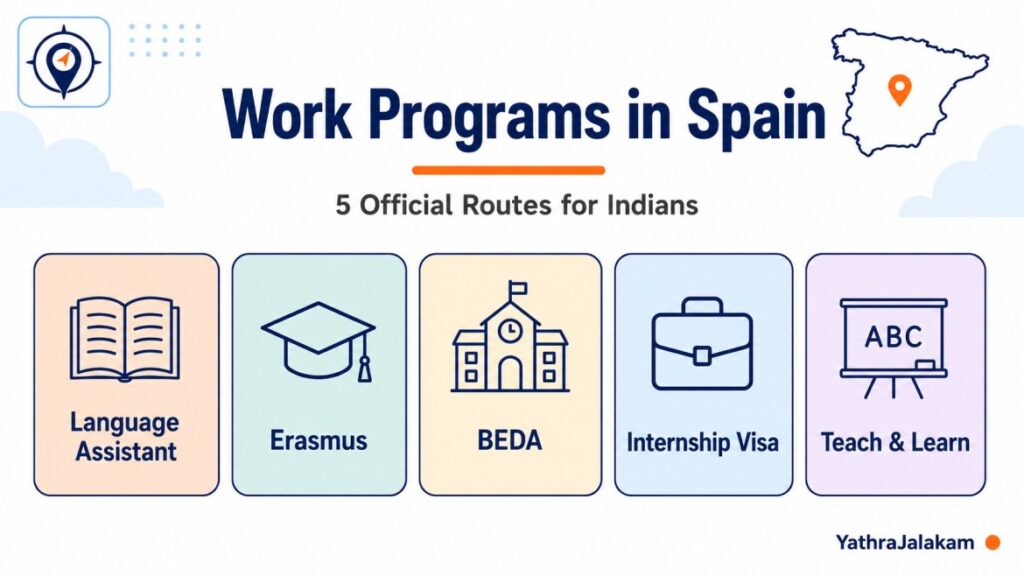
Each program below has different requirements, different timelines, and suits different life situations. Read through all five before deciding which path makes sense for you.
▶️ Watch Full Video👇
Which Programs Can Indians Actually Use to Work in Spain?
The short answer is – more than most people realise. Spain has bilateral education agreements with India, participates in EU-wide scholarship frameworks, and has a specific internship visa category that most Indians have never heard about. The programs range from a government-run language assistant scheme with zero application fees, to a fully funded EU scholarship worth up to €1,400 (approx. ₹1,26,000) per month, to a graduate program where you earn a master’s degree and get paid while doing it. The real picture of Spain for Indians is actually more welcoming than the internet makes it seem.
One thing we want to say upfront: competition for all of these programs is real. These are not backdoor shortcuts. They are structured, official pathways – and if you prepare properly, research thoroughly, and apply on time through the official channels, your chances are genuinely good. What hurts people is either not knowing these programs exist, or wasting months going through agents who charge fees to do what you can do for free online.
1. Language Assistant Program – The Government Route for Indians
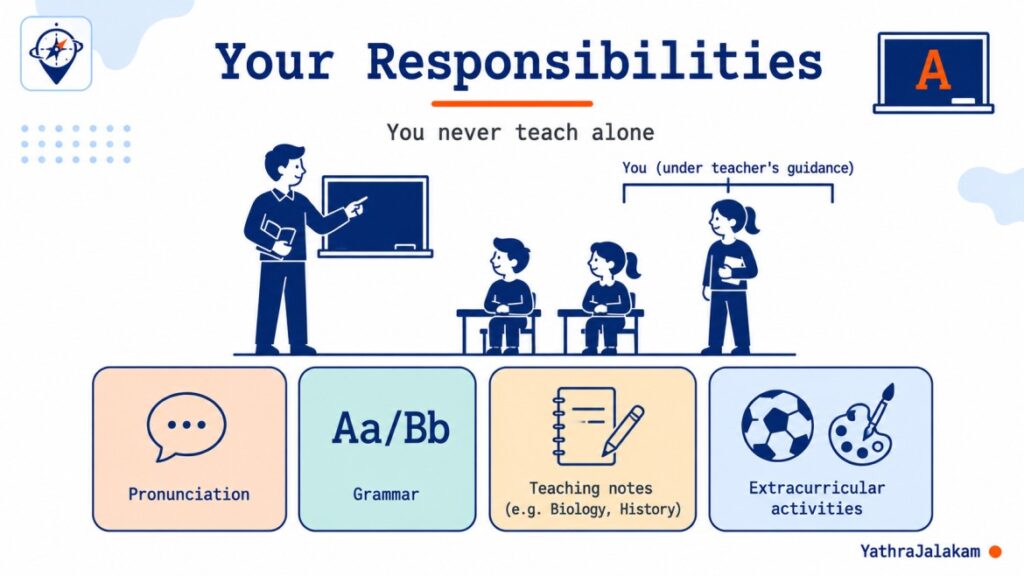
This is the most well-known of the five options and it is entirely run by the Spanish Ministry of Education. Under this program, you are placed in a public school somewhere in Spain and you work alongside the regular English teacher – not solo – helping students with pronunciation, conversation, and comprehension. Think of yourself as the living, breathing version of a native English speaker in the classroom. You also share Indian culture, festivals, food traditions, and language with students, which makes this genuinely two-way exchange and not just a job.
The 2026-2027 cycle runs from November 1, 2026 to May 31, 2027. You work between 14 and 16 hours per week, and the stipend starts at €800 to €1,000 per month (approx. ₹87699 to ₹109625) depending on the region you are placed in. Some regions like Madrid tend to be on the higher end. The application portal for the 2026-2027 cycle was open from June 2 to June 30, 2026 – so if you are reading this before that deadline, move fast. If you missed it, start preparing your documents now for next year’s cycle, because the application window opens again usually in early summer.
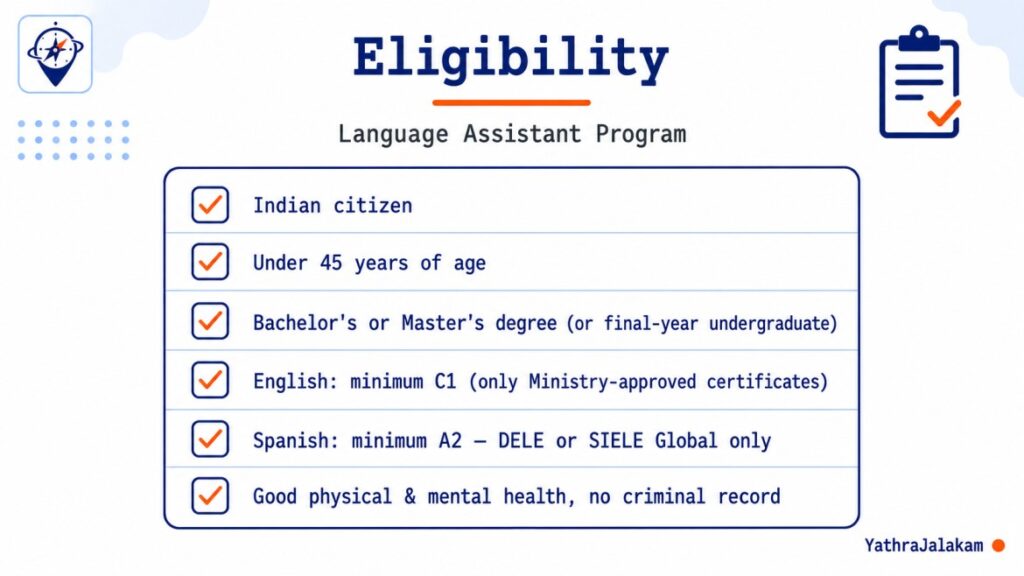
Eligibility for Indians (2026-2027 cycle):
- Indian citizen with a valid passport (must be valid until at least November 2027)
- Under 45 years of age (for new applicants)
- A recognised university degree or in the final year of a bachelor’s program
- Minimum C1 English proficiency certificate from the Ministry’s approved list
- Minimum A2 Spanish proficiency certified by DELE or SIELE Global
- Good physical and mental health, no criminal record
Indians can stay in this program for a maximum of two years total. There is no extension beyond that, even if the visa is renewed. This is unlike some other nationalities who can renew for longer. Plan accordingly – two years is a solid foundation to get your foot in the door, learn Spanish properly, and figure out your next move in Europe. If you are wondering how long it actually takes to become functional in Spanish, our honest guide on learning Spanish as an Indian expat covers that in detail.
📌 Official Resource: Spanish Ministry of Education – Language and Culture Assistants Program for India Visit Official Website
2. Erasmus Mundus Scholarship – The Fully Funded Masters Route
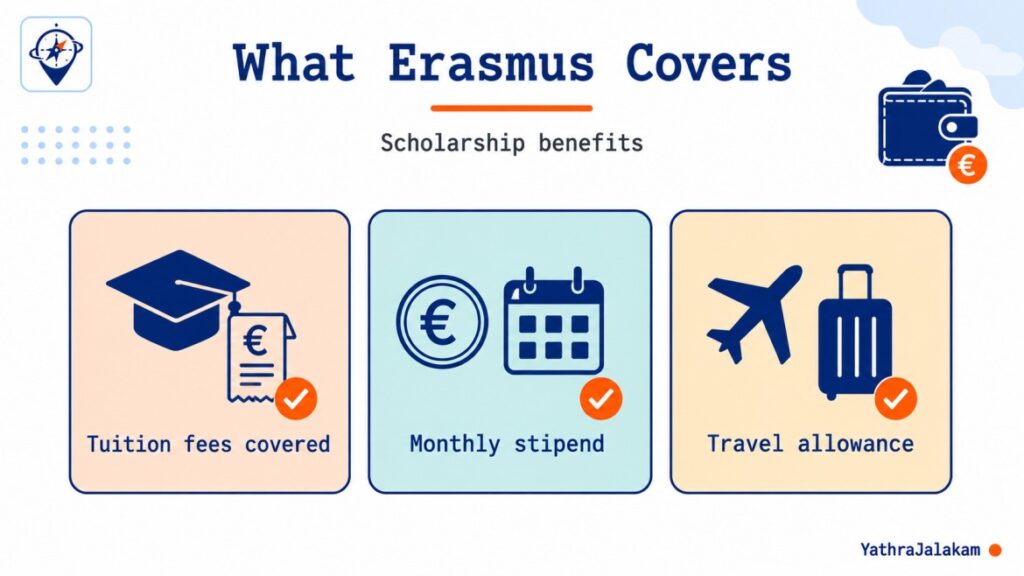
The Erasmus Mundus Joint Masters (EMJM) is the European Union’s flagship scholarship for international students, and India is classified as a “Partner Country” – which is actually the better funding tier. That means Indians qualify for the full €1,400 per month (approx. ₹1,26,000) stipend, plus a travel allowance of up to €3,000 per year (approx. ₹2,70,000) to cover flights and relocation. On top of that, 100% of your tuition fees are covered, and you get health insurance for the entire duration of the program. You study across at least two or three European countries as part of the joint master’s structure – Spain is regularly among the participating countries.
This is genuinely one of the best-funded study programs available to Indian students anywhere in the world, but let’s be completely honest about the competition. Only 101 Indian students received this scholarship in 2025, down from 161 in previous years. Acceptance rates for individual programs can be as low as 1 to 5%. This is not a program you apply to casually. The next application cycle opens in October 2026 for September 2027 entry, and the strongest applications are built over six to twelve months of preparation. Your academic record, research profile, statement of purpose, and letters of recommendation all carry serious weight.
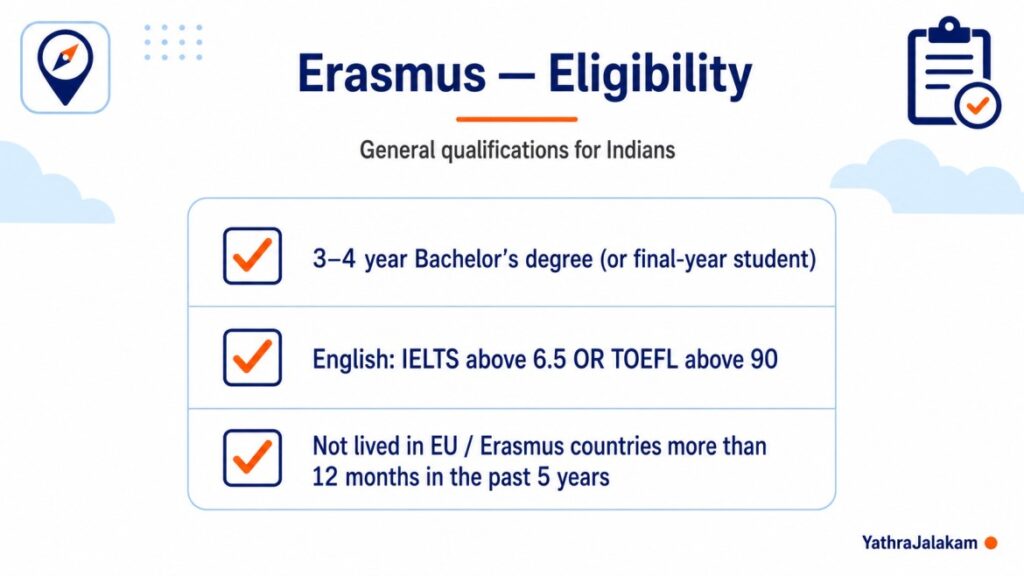
General Eligibility:
- A 3 or 4 year bachelor’s degree from a recognised university (or final year student)
- IELTS score above 6.5 or TOEFL above 90 (requirements vary by program)
- You must not have lived in an EU or Erasmus country for more than 12 months in the past 5 years
- Strong academic record and a compelling research profile
The program covers over 150 joint master’s programs across virtually every subject area. You apply not to the EU directly, but to a specific joint master’s program – each has its own deadline, usually between October and January. Do not confuse this with the general Erasmus+ student exchange, which is a different and less funded program. The reality of student life in Spain is worth reading before you commit to this path, because fully funded does not mean stress-free.
📌 Official Resource: Erasmus Mundus Joint Masters – European Commission Catalogue Visit Official Website
3. BEDA Program – Language Assistant in Catholic Schools
The BEDA (Bilingual English Development and Assessment) program is run by Escuelas Católicas de Madrid and places language assistants in private and semi-funded Catholic schools. The structure is similar to the government Language Assistant Program – you support the main English teacher, help with pronunciation and conversation, assist with teaching notes, and get involved in extracurricular activities. What makes BEDA different is the environment: smaller, more structured school settings with stronger support systems for assistants, and a faith-based school culture that many participants describe as warmer and more community-oriented than public schools.
The stipend under BEDA ranges from €800 to €1,000 per month (approx. ₹89,000 to ₹90,000) depending on your hours. You work 18 to 24 hours per week from September to June. Schools are primarily in Madrid, but there are also placements in Alicante, A Coruña, Albacete, Asturias, Castellón, Valencia, and Zaragoza.
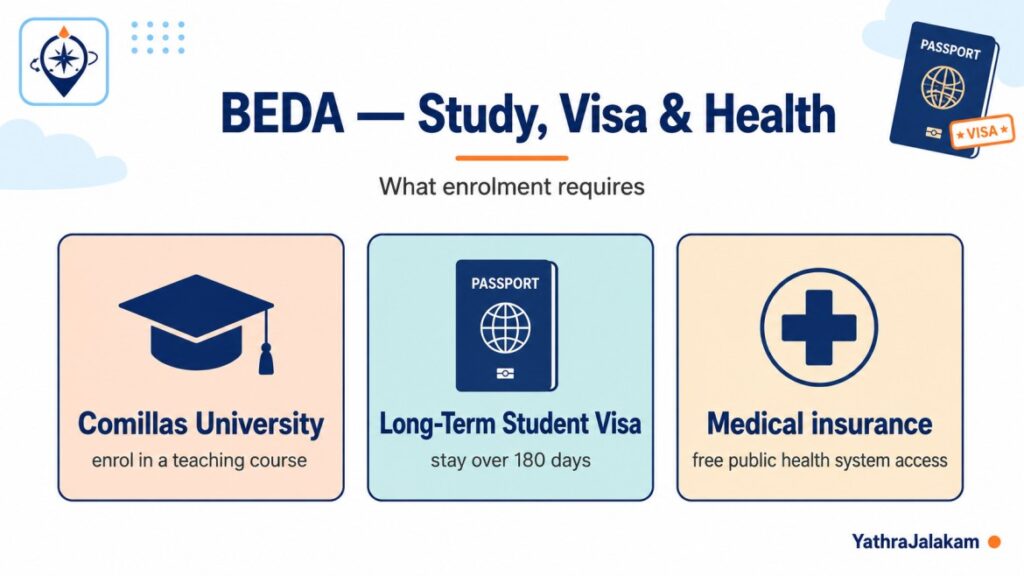
Note: unlike the government program, BEDA also requires you to enroll as a student at Comillas Pontifical University and complete a teaching methodology course. This means you need a long-term student visa for Spain (valid beyond 180 days), not just a short-stay visa.
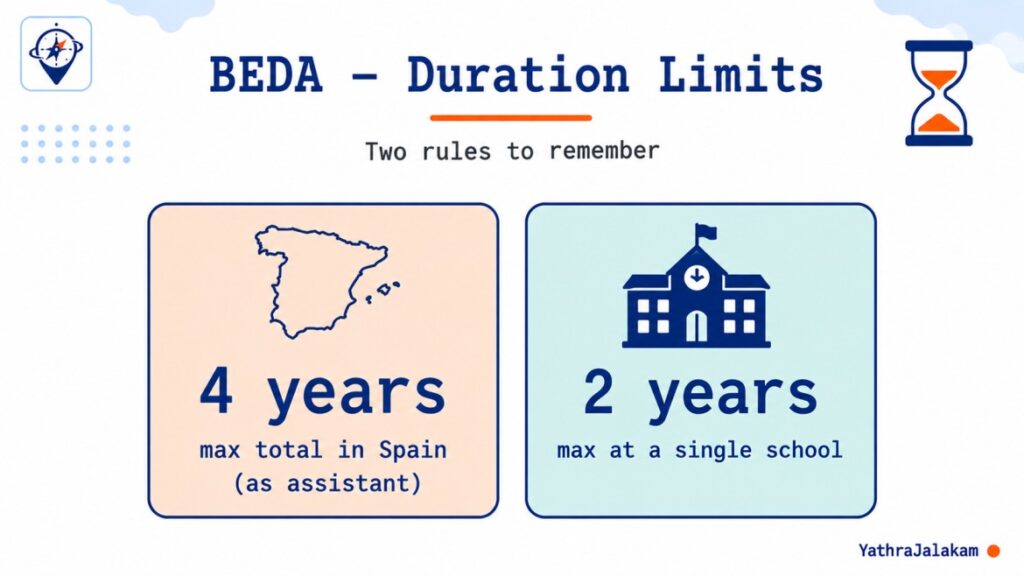
The real advantage of BEDA for Indians is that Spanish is not required and prior teaching experience is not required either. You can stay in the program for up to four years total, though you cannot remain at the same school for more than two years.
BEDA also provides private health insurance as part of the package, which is a significant saving. You do not need to be Catholic to apply – but you do need to be comfortable and respectful in a Catholic school environment throughout the academic year.
Eligibility for BEDA:
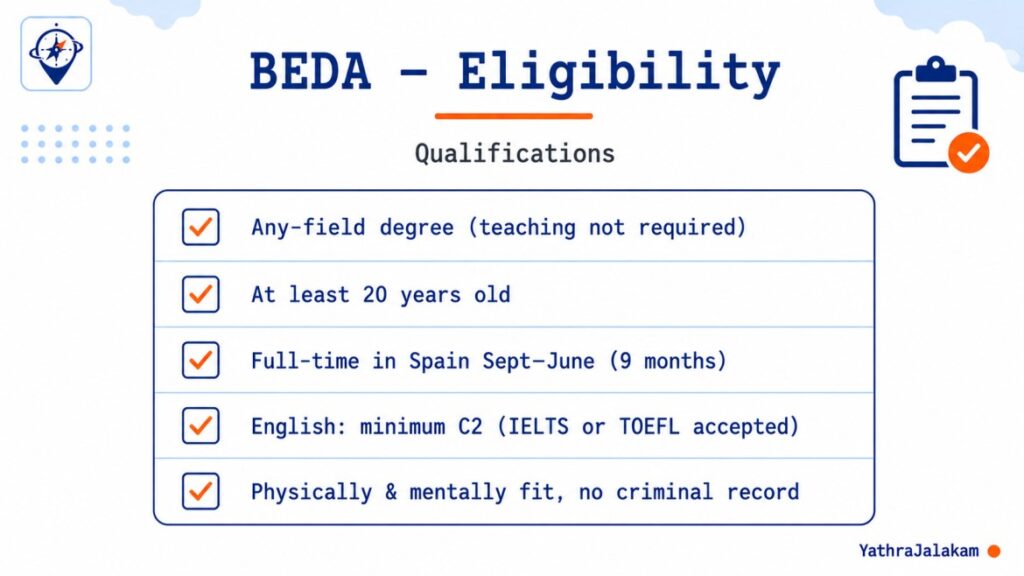
- A bachelor’s degree in any subject (does not need to be in education or teaching)
- Minimum age of 20 – 56 years
- Minimum C2 level English proficiency (IELTS or TOEFL certificate accepted)
- Good physical and mental health, clean criminal record
- Must be available full-time in Spain from September through June
Applications are now open to the Program in 2026-2027
| Candidate Category | Application Deadline | Important Notes |
|---|---|---|
| EU passport holders | 28 February 2027 | Eligible to apply under the EU passport holder category. |
| Non-EU candidates with a valid visa | 28 February 2027 | Examples include active work and residency visas, family member of EU citizen visas, etc. |
| Non-EU candidates with a valid visa who are willing to obtain a new student visa from their country of origin | 31 August 2026 | Any candidate currently in Spain on a student visa, if selected, must obtain a new Higher Studies student visa from their country of origin. |
| Non-EU and UK citizens who require a new visa to participate in the Program | 31 August 2026 | Candidates must apply for a new Higher Studies visa to participate. |
| UK citizens with a valid NIE registry certificate proving residency before Brexit | 28 February 2027 | The NIE registry certificate must prove residency obtained prior to Brexit. |
📌 Official Resource: BEDA Program – Escuelas Católicas de Madrid Visit Official Website.
Application Link – BEDA Program – Language Assistant in Catholic Schools
4. Internship Visa (Visado de Prácticas) – For Students and Recent Graduates
This is probably the least talked-about option in Indian circles, and honestly it is quite underrated. Spain has a specific visa category called the Visado de Prácticas (Internship Visa) designed for people who want to do a formal internship at a Spanish company or institution. This is not a work visa in the traditional sense – it is specifically for structured training or internship arrangements – but it gives you legitimate presence in Spain, real professional experience, and importantly, a legal path that does not require a job offer in the conventional sense.
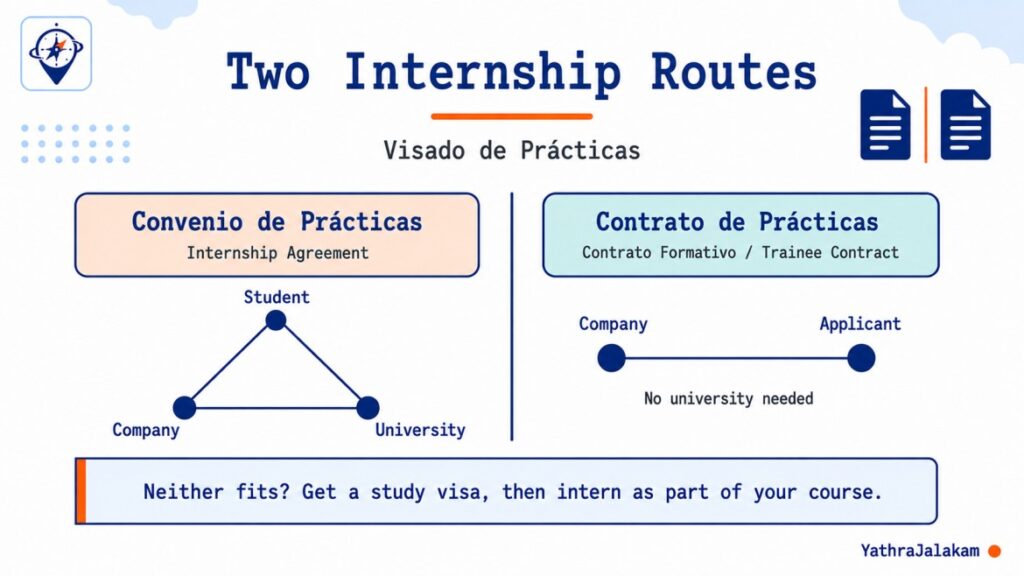
The internship under this visa comes in two forms. The first is a Convenio de Prácticas – a three-way agreement between you, a Spanish company, and your university. This is common when you are studying a course that includes a mandatory placement component. The second form is a Contrato de Prácticas or Contrato de Formación, which is a direct agreement between you and the company with no university involvement required. This second route is more accessible if you have graduated recently.
Key Conditions:
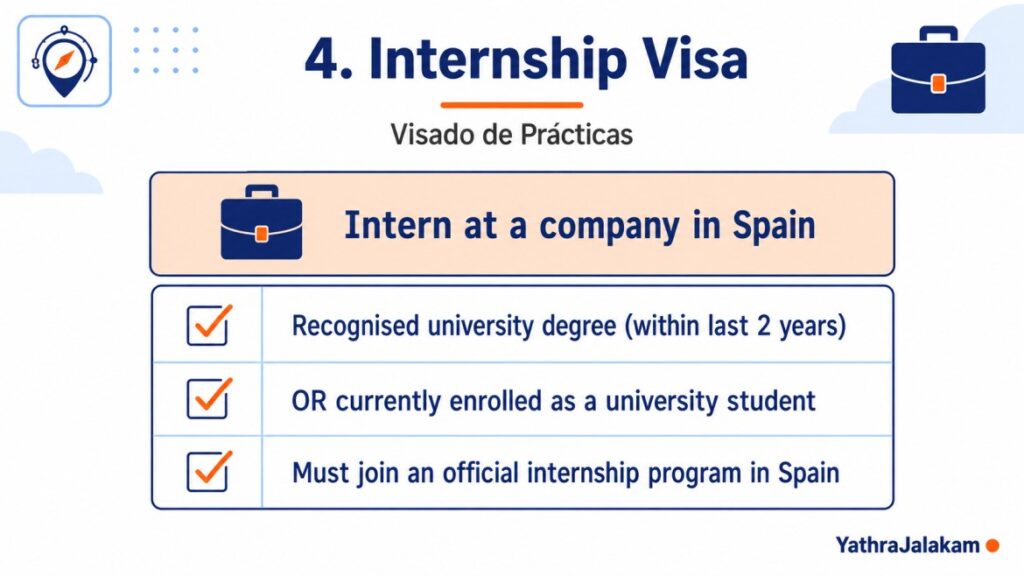
- A recognised university degree (awarded not more than 2 years before the internship start)
- OR currently enrolled as a university student
- Must be part of an official internship program recognised in Spain
- If neither condition applies, you need a study visa to enrol in a course in Spain that includes a placement component
Our honest Suggestion here: if you have recently graduated and have a skill set that matches what Spanish companies are hiring for – tech, engineering, data, finance – this is worth exploring seriously. The high-demand job sectors in Spain for Indians in 2026 give you a sense of where internship demand is actually concentrated. Friends of ours who came through agents told us they spent thousands on “internship placement services” that did nothing except connect them to the same Linkedin job board they could have used themselves. Save that money.
📌 Official Resource: Practicas and Study Visas Visit Official Page
5. Teach and Learn in Spain – Earn a Master’s While You Work
This is the most structured of the five options and also the most academically valuable in the long run. The Teach and Learn in Spain program is run by Instituto Franklin, which operates under the University of Alcalá. In this program, you earn a full master’s degree (worth 60 ECTS credits, fully accredited) while simultaneously working as a language assistant in a school in the Madrid region. The master’s programs available include International Education, Teaching, Bilingual and Multicultural Education, School Management, and a few others. The program runs September to June.
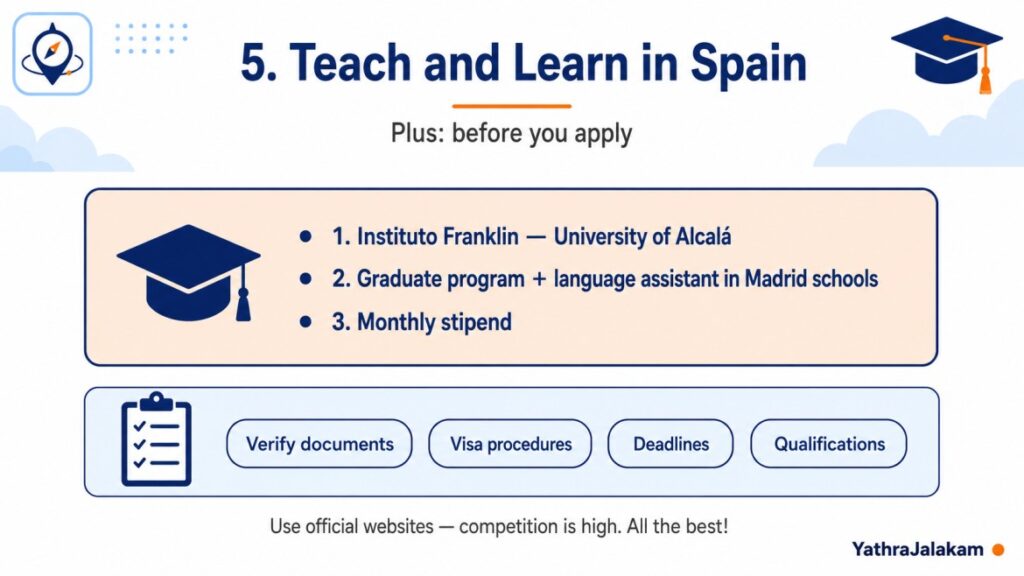
You receive a monthly stipend as a language assistant, and the program also includes health insurance and support services for things like residency paperwork and banking – which is genuinely helpful when you are new to Spain. The program works on two placement tracks: Option A places you in private or concertado (semi-funded) schools, and Option B places you in public schools through the Spanish Ministry’s program. For 2026-2027, Option B placements are subject to availability due to ongoing restructuring of the government program, so if you are applying now, have a funding backup plan ready.
The practical upside of this program over the standalone government language assistant route is clear: you leave with a Spanish master’s degree on your CV, real classroom experience logged formally, and a network of educators across Madrid. For anyone who wants to build a long-term career in education in Europe, this is probably the most strategic of all five options.
📌 Official Resource: Instituto Franklin – Teach and Learn in Spain Program Visit Official Website
Quick Comparison: Which Program is Right for You?
Program Best For Monthly Stipend Duration Spanish Required? Application Fee Language Assistant (Ministry) Graduates wanting to experience Spain with minimal requirements €800 – €1,000 (₹73,000 – ₹90,000) Up to 2 years Yes – A2 minimum Free Erasmus Mundus High-achieving students wanting a funded European master’s €1,400 (₹1,26,000) Up to 24 months Depends on program Free BEDA Program Graduates open to Catholic schools, no Spanish needed €800 – €1,000 (₹89,000 – ₹90,000) Up to 4 years No Free Internship Visa Recent graduates with a specific professional skill set Varies by company Defined by contract Helpful but not mandatory Visa fee applies Teach and Learn (Instituto Franklin) Those wanting a master’s degree alongside work experience Stipend + master’s included September – June (renewable) No – but helpful Program fee applies What Documents Do You Typically Need?
While each program has its own specific document checklist, there are common items that appear across almost all five of these applications. Starting to collect these early will save you a lot of stress, especially when you are dealing with apostilles and translations from India.
- Valid passport – for the Language Assistant program (2026-2027), it must be valid until at least November 2027
- Degree certificate with apostille – your Indian degree needs an apostille from the Ministry of External Affairs in India before it is recognised in Spain
- English proficiency certificate – C1 for the government program, C2 for BEDA, IELTS/TOEFL for Erasmus; check the specific approved list for each program
- Spanish proficiency certificate – A2 minimum for the government Language Assistant program (DELE or SIELE Global)
- Police clearance certificate – from India, apostilled; required by all five programs
- Medical certificate – confirming fitness to work with children
- Passport-size photos – per Spanish consulate specifications
- Statement of purpose or motivation letter – especially important for Erasmus and Instituto Franklin
One thing people who came without doing proper research face a lot is the apostille confusion. Getting your Indian degree apostilled takes time and multiple steps – and if you leave it for the last moment, you will miss the application window. Start this process at least three months before any deadline you are targeting.
Final Thoughts
Spain genuinely wants English-speaking graduates to come here and contribute to its bilingual education push – the government program exists because there is real demand in public schools across all 17 regions. The EU funds Erasmus Mundus because it wants talented Indian students in European classrooms. These are not hidden opportunities or secret loopholes. They are offical, structured, well-documented pathways that simply do not get talked about enough in Indian circles because the people who know about them are not selling anything.
Our honest suggestion would be to pick the program that most closely matches where you are right now. Recent graduate with strong English? Government Language Assistant or BEDA. High achiever with a research focus? Start building your Erasmus application twelve months out. Got a skill set that matches what Spanish companies need? Explore the internship visa route. Want a master’s degree and classroom experience together? Instituto Franklin is hard to beat. Whatever you choose, apply directly through the official website, read every condition carefully, and get your documents apostilled well in advance.
Europe is not as far as it feels from India. We figured all of this out ourselves, sitting in our home with a laptop and a lot of patience – and later, Madrid genuinely feels like home. If we could do it, so can you.
Frequently Asked Questions
Can Indians apply for the Language Assistant Program in Spain without knowing Spanish?
No – the Spanish government requires a minimum A2 level Spanish certificate (DELE or SIELE Global) for Indian applicants specifically. This is stricter than the requirement for some other nationalities. Start preparing for your DELE A2 exam well in advance because it requires booking, preparation, and waiting for results – it is not something you can do in two weeks.
Is the BEDA program safe and legitimate for Indians?
Yes, BEDA is a long-standing program run by Escuelas Católicas de Madrid, a formal educational body with hundreds of affiliated schools. It has been placing language assistants for decades and includes private health insurance and residency support as part of the package. You do not need to be Catholic – but you should be comfortable working in a faith-based school environment for nine months of the year.
How much does the Erasmus Mundus Scholarship pay Indian students?
Indian students classified as “Partner Country” nationals receive the full €1,400 per month (approx. ₹1,26,000) for up to 24 months, plus a travel allowance of up to €3,000 per year (approx. ₹2,70,000) for long-distance travel from India. Tuition fees and health insurance are also fully covered. It is however extremely competitive – only around 100 Indian students receive it per year globally across all programs.
Do I need a job offer to apply for the Internship Visa for Spain?
Not a conventional job offer – but you do need a formal internship agreement, either a Convenio de Prácticas (three-way agreement with a university) or a Contrato de Prácticas (direct company contract). If you are a recent graduate without current university enrollment, the Contrato de Prácticas is the route – but your degree cannot be older than two years at the time of application.
Can I work extra hours outside these programs to earn more?
It depends on your visa type. Language assistant visas typically have restrictions on additional work. The long-term student visa used for BEDA and Instituto Franklin has specific limits on work hours (usually up to 20 hours per week for part-time additional work). Always check the current terms of your specific visa category before taking on any additional paid work – rules can change and the consulate is the authoritative source.
Is it worth going through an agent to apply for these programs?
No – and we want to be very direct about this. Every single one of these five programs has free, publicly available applications on official government or institutional websites. Agents charge anywhere from ₹50,000 to ₹2,00,000 (and sometimes more) for doing exactly what you can do yourself with a few hours of careful reading. Several people we know paid agents and still ended up having to fix their own paperwork mistakes at the consulate. Do your own research, verify everything on the official sites, and keep that money for settling in Spain.
Found this helpful? Share it with someone planning to move to Spain. Subscribe to our Life in Spain for Indians YouTube channel for real, honest videos about life in Spain – and follow us on Instagram for daily updates: Spain News for Indians.