High Demand Jobs in Spain 2026 – Best Roles and Visa Options for Indians
If you are an Indian IT professional sitting in Bangalore, Dubai, or even somewhere in Europe and scrolling through LinkedIn job posts showing 50,000 euro salaries in Spain, we completely understand why your eyes light up. But here is the thing nobody tells you – the reality on the ground is quite different from what those job listings show, and we want to give you the honest picture before you make any big decisions.
We have been living and working in Spain for several years now. We figured this out ourselves – no agents, no consultants, no one holding our hand. And because of the work we do, we also get to sit on the other side of the table, interviewing candidates for our company. We have seen people arrive here without proper research and get completely stuck – no job, savings draining, and eventually heading back home. We have also seen people who prepared well from India itself, found a job before landing, and are now thriving here. This article is for the second type of person. Let us walk you through everything.
Which IT Roles Are Actually in Demand in Spain Right Now?
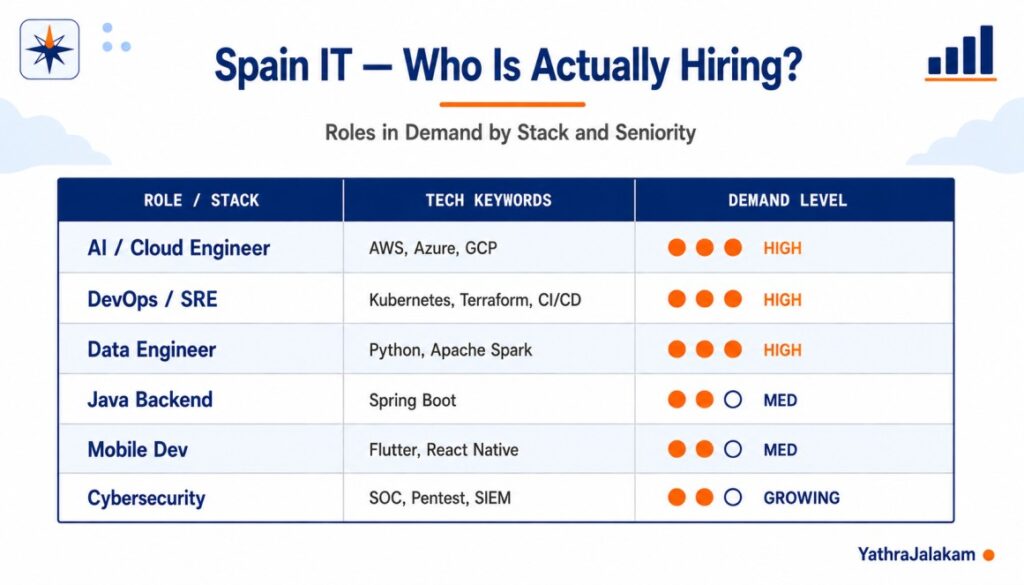
When we say IT jobs in Spain, people imagine a huge and uniform market. But honestly, the demand is very concentrated in specific fields. The four areas with the strongest and most consistent demand in 2026 are Cybersecurity, Cloud Engineering, Data Engineering, and Artificial Intelligence or Machine Learning. These four fields are where companies are genuinely hiring and where you will find the most open positions on any given week.
Watch Here 👇
Cybersecurity in particular is booming here. European regulations around data protection and compliance have pushed every major company – banks, telecoms, public sector – to invest heavily in security teams. Cloud engineering is similar. Most Spanish enterprises are in the middle of their digital transformation and they need people who know AWS, Azure, or GCP properly. Data engineering and AI roles are also at peak demand in 2026 according to multiple salary benchmarks we have checked.
Beyond those four, Java backend development and mobile application development (especially React Native and Flutter) have decent scope. Network administration and system administration also exist as fields, but here is a realistic thing to consider – in a typical Spanish IT company of 100 people, around 90 will be developers or engineers. Only about 10 people handle network and sysadmin functions. So those roles exist but the competition for the smaller number of openings can be intense.
📌 “The four fields with strongest IT demand in Spain right now are Cybersecurity, Cloud Engineering, Data Engineering, and AI. If your skills align with any of these, Spain is a market worth pursuing seriously in 2026.”
How Much Salary Can Indians Realistically Expect in Spain IT Jobs?
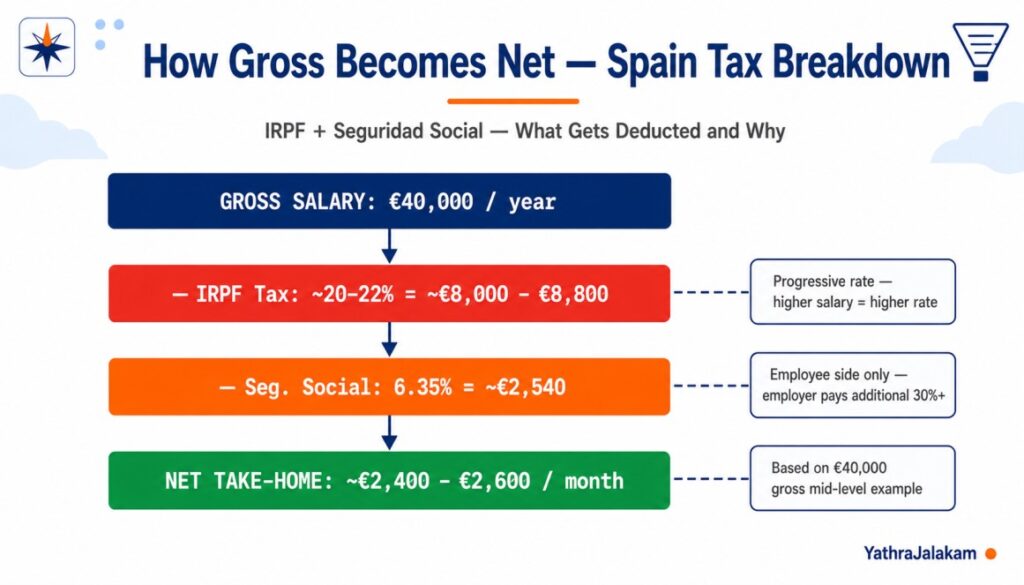
This is the most important section because this is where people have the most unrealistic expectations. Let us be very direct about this. When you see a job post saying 50,000 euros annual salary, that is the gross salary – before income tax and social security contributions are deducted. By the time you actually receive money in your bank account every month, the number will be significantly smaller. Spain has a progressive income tax system, meaning the more you earn, the higher the percentage you pay. Add social security contributions on top of that, and you are looking at a real take-home that is noticeably lower than the advertised figure.
Now let us look at realistic salary ranges by experience level for IT roles in Spain for 2026. We are giving you gross annual figures here, which is how job posts display them.
| Experience Level | Gross Annual Salary (EUR) | Approx. in Indian Rupees |
|---|---|---|
| Junior (1-3 years) | €24,000 – €32,000 | Rs. 21.5 lakh – Rs. 28.5 lakh |
| Mid-Level (3-6 years) | €35,000 – €50,000 | Rs. 31 lakh – Rs. 45 lakh |
| Senior / Lead (7+ years) | €50,000 – €70,000 | Rs. 45 lakh – Rs. 63 lakh |
| Cybersecurity Specialist (senior) | €60,000 – €89,000 | Rs. 54 lakh – Rs. 80 lakh |
| Cloud Engineer (average) | €44,000 – €72,000 | Rs. 39 lakh – Rs. 65 lakh |
When you compare this to what top IT professionals earn in Bangalore or Hyderabad right now, especially at product companies, the numbers are not always dramatically different after you account for cost of living adjustments. The real advantage of working in Spain is not just the salary number – it is the lifestyle, the social security system, the EU residency benefits, and the long-term stability. But if you are purely chasing a higher rupee income, you need to do your math carefully.
Also worth noting – Madrid and Barcelona will generally pay better than smaller cities like Seville or Valencia. The difference can be noticeable, and English-language positions are far more available in the two major cities as well.
Do You Need Spanish Language Skills to Get an IT Job in Spain?
This is probably the question we get asked the most, and the answer is – it depends. Not a very satisfying answer, we know, but let us break it down properly. If you are applying to a purely local Spanish company where all the clients are Spanish-speaking and all the internal communication happens in Spanish, then yes, you will almost certainly need Spanish. The interviews will be in Spanish, the day-to-day work will be in Spanish, and you will not survive long without it.
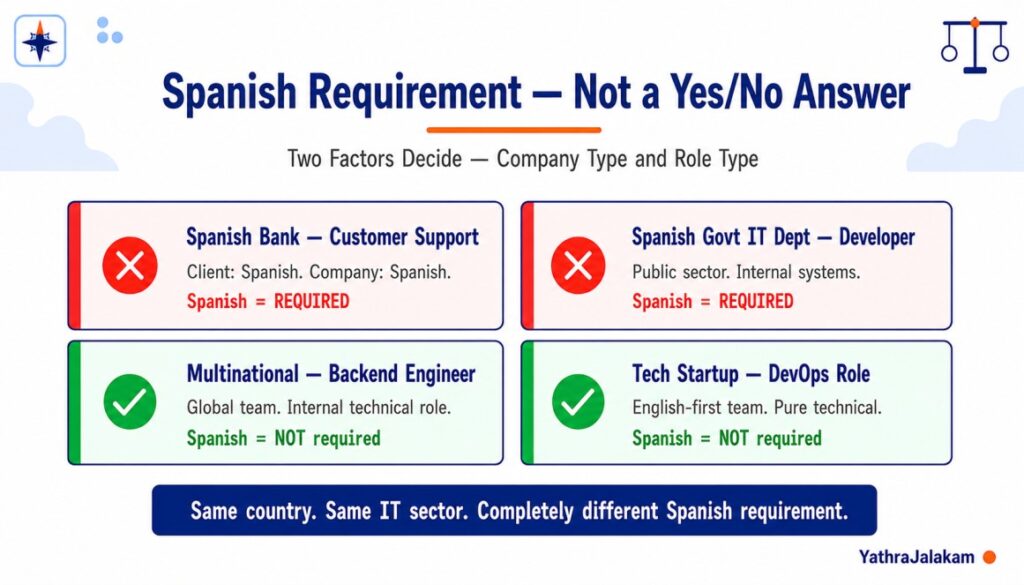
However, multinational companies – and there are many of them in Madrid and Barcelona – typically operate in English as their standard communication language. While considering the Indians working at companies like Accenture, Capgemini, IBM, and various fintech startups here, and many of them manage perfectly fine with English, at least for the first couple of years. For cybersecurity, cloud, and AI roles especially, multinational companies are actively looking for skilled professionals and English is accepted.
Our suggestion would be this – start learning Spanish regardless. Even a basic A2 or B1 level will open so many more doors, make your daily life here much smoother, and show employers that you are serious about integrating. People who came here thinking English alone would be enough for the long term have told us it creates a ceiling at some point. It does not have to stop you from applying now, but treat Spanish learning as a parallel investment you start immediately.
Where Should Indians Search for IT Jobs in Spain?
LinkedIn is the obvious starting point and yes, it is used heavily in Spain. A lot of listings do come through LinkedIn and it is worth having a strong, optimised profile. But if you are only using LinkedIn, you are missing a significant chunk of the Spanish IT job market.
There are two other platforms that are very widely used here which most Indians do not know about back in India. The first is Tecnoempleo – this is a job portal focused specifically on tech and IT roles in Spain and it is used heavily by IT companies here. The second is InfoJobs, which is a broader Spanish job platform but still very relevant for IT positions. Both of these are worth creating profiles on and checking regularly.
One very important warning – all of these platforms have scam listings. This has become a genuine problem. The safest way to apply is this – when you see a job posting on any platform, go directly to the company’s official website and apply through their careers page. Company websites have almost zero risk of hosting scam listings. Never share bank details, pay any fees, or download software as part of a job application process.
📌 Official Resource: Tecnoempleo is Spain’s dedicated tech job portal used by most IT companies in the country. A must-bookmark if you are seriously looking for IT jobs in Spain. Visit Tecnoempleo
📌 Official Resource: InfoJobs is one of the most popular general job portals in Spain with a large number of IT listings across all major cities. Visit InfoJobs
How Should Indians Prepare Their Resume for Spanish IT Companies?
Resume preparation is one of those things that can make or break your application before any human even looks at it. In Spain, as in most of Europe, resumes go through an ATS – an Applicant Tracking System – before a recruiter sees them. This software scans for keywords. If your resume does not contain the right keywords matching the job description, it gets filtered out automatically. We have seen very qualified candidates from India getting zero responses simply because their resume was not optimised for this process.
A few key things to keep in mind for your resume when applying to Spain:
- Keep it to 1-2 pages maximum – European employers do not want a 4 or 5 page CV.
- Include only relevant and specific experience matching the job role you are applying for.
- Pack in keywords from the job description – technology names, certifications, tools, frameworks.
- Export it as a PDF in a clean single-column format that ATS software can parse easily.
- Add a professional photo if you want – unlike the US, it is generally accepted in Spain.
- Do not include irrelevant personal details like marital status or religion.
What Visa Options Does an Indian IT Professional Have to Work in Spain?
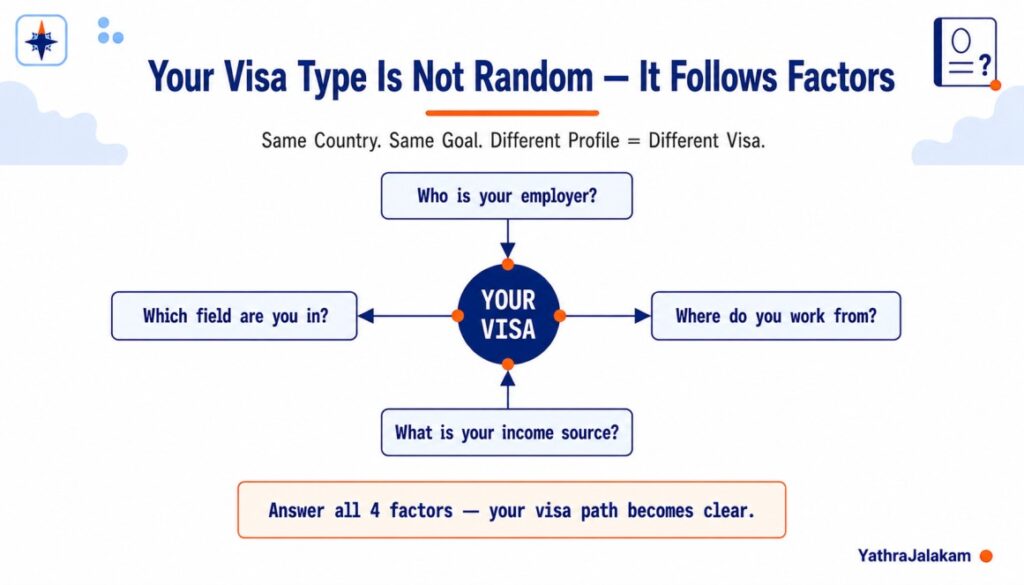
Nobody tells you this clearly enough – there is no specific “IT visa” for Spain. The visa you get depends on who your employer is, what your salary is, and how you will be working. There are four main visa routes relevant for Indian IT professionals and each has very different conditions. Let us walk through all of them honestly.
What Is the HQP Visa in Spain and Who Qualifies for It?
The HQP – Highly Qualified Professional – visa, also called PAC or the highly skilled worker permit, is the most relevant route for Indian IT professionals being hired directly by a Spanish or European company. This is genuinely a good visa. If a company in Spain is hiring you for a cybersecurity, cloud, data, or AI role and your salary meets the threshold, this is most likely the route you will take.
Youth Reduction for Highly Qualified Professionals (HQP) – Spain offers a 25% discount on the standard salary requirements for younger professionals, making the visa more accessible to recent graduates and younger talent entering the job market. So, for this, the minimum salary thresholds are: at least €40,077 gross annual for scientific and technical professionals (which covers most IT roles), and at least €54,142 for director or managerial level roles. There is also a reduced threshold for applicants under 30 years old.
The big advantages of this visa are real. Your spouse can come and work legally. Your children come with you.In 2026, the initial permit is valid for up to 2 years. You can travel freely across the Schengen zone. The employer applies on your behalf through a special unit called UGE-CE, and the typical processing time is around 20 working days – very fast by immigration standards. After 5 years of continuous residence, you can apply for long-term residency.
📌 Official Resource: Spain’s official immigration unit UGE-CE handles HQP permit applications. All requirements, forms, and procedures are listed on the Spanish government’s immigration portal. Visit Official Spain Immigration Portal
Can an Indian Remote Worker Apply for the Spain Digital Nomad Visa in 2026?
If you are working remotely for a company outside Spain – say you are employed by an Indian IT company or a US startup and you work fully remotely – then the Digital Nomad Visa is your route. Spain introduced this visa in 2023 under the Startup Act and it has become quite popular. The Spanish government has officially confirmed that the minimum monthly income threshold remains €2,762 per month for 2026 for a single applicant. That works out to roughly Rs. 2.5 lakh per month at current rates.
If you are bringing your spouse, the requirement goes up by another €1,069 per month. And for each child, add €357 per month on top of that. So for a family of three, you would need to show approximately €4,274 monthly income. These are hard requirements and the income authorities are checking bank statements carefully – not just contracts on paper.
You also need at least a bachelor’s degree or three years of relevant professional experience, a remote work contract or proof of freelance clients (for at least 3 months), and private health insurance until you are registered with Spanish social security. The initial visa from a Spanish consulate abroad is valid for one year; if you apply from within Spain, you can get a three year residence permit directly. One big bonus – the Beckham Law tax regime lets digital nomad visa holders pay a flat 24% tax on Spanish income up to €600,000 instead of the progressive rates that can reach 47%. That is a significant financail advantage for higher earners.
📌 Official Resource: Spain’s official Digital Nomad Visa information is published by the Ministry of Inclusion, Social Security and Migration. Check requirements and how to apply here. Visit Spain Digital Nomad Visa Official Page
What Is the ICT Permit and Who Does It Apply To?
The ICT permit – Intra-Company Transfer – is for people who work for a company that has offices both in India and in Spain. Think TCS, Infosys, Wipro, Capgemini, or Accenture. For example, If you are working for TCS in India and TCS Spain has an opening, they may transfer you internally for a project period. The permit covers this type of move.
We will be honest about the ICT route – it is not ideal for long-term plans. The salary you get under an ICT transfer is typically lower than what a Spanish or European company would directly offer you for the same role. There are also more restrictions on what you can do, and the position is usually for a fixed project period, meaning you may have to return to India after the project ends. It is a way in, but it should not be confused with the stability and growth potential of a direct hire.
Is the EU Blue Card Available for Indian IT Professionals in Spain?
Yes, the EU Blue Card is now properly available in Spain following the 2023 reforms that aligned Spanish law with the EU directive. It works similarly to the HQP visa in that a Spanish company must sponsor you, but the salary threshold for the Blue Card follows a different formula – 1.4 times the average gross annual salary as published by Spain’s national statistics institute INE. The exact figure for 2026 has been set by official government order (Order PJC/44/2026 published in the BOE on January 30, 2026). The Blue Card also allows you to move more freely to other EU countries after 12 months of holding it, which makes it attractive if you are thinking about Europe more broadly. Your employer applies on your behalf.
Is It Easy or Difficult to Get an IT Job in Spain as an Indian?
We need to answer this honestly because a lot of content out there is either too optimistic or too discouraging. The real answer is – it is possible but it is genuinely competitive and you cannot approach it casually.
Compared to non-technical fields, technical IT roles are significantly easier to find in Spain. A Spanish marketing professional or HR manager has it much harder than a cybersecurity engineer or a cloud architect. In that sense, being in IT is a genuine advantage here. But here is what nobody talks about enough – people from all over the world are applying for these same Spanish IT jobs. Brazilian, Mexican, Colombian, Romanian, Ukrainian engineers are also competing for these exact same positions. Spain is attractive to talent from Latin America especially because of the language, so the competition pool is truly international.
The second honest reality is that compared to other EU countries like Germany, Netherlands, or France, Spain has fewer IT vacancies and lower salaries. So Spain requires more effort per application than some of its neighbors. This does not mean do not try – it means go in with your eyes open and maybe have parallel applications running across multiple EU countries if possible.
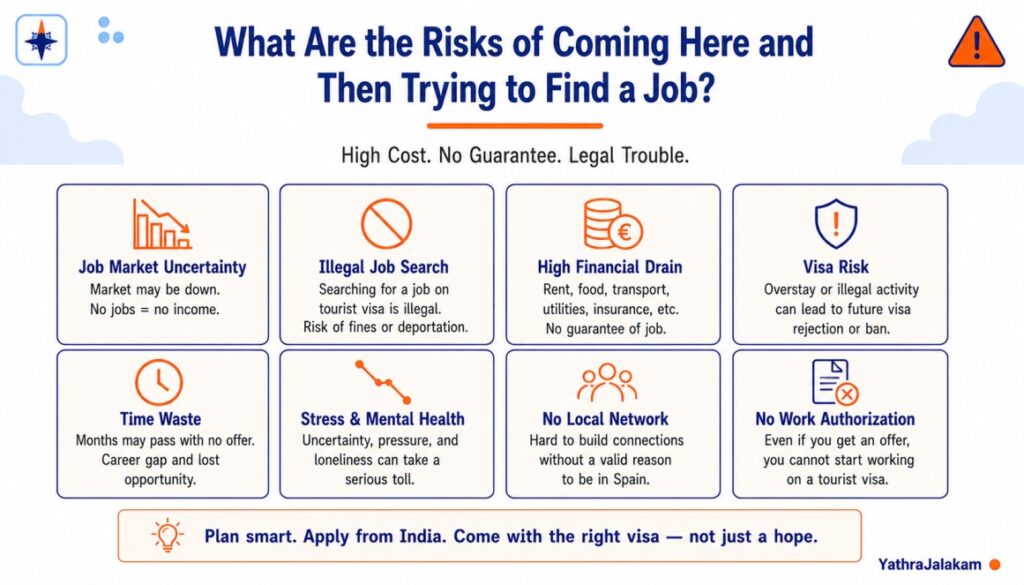
And please, nobody tells you this but we will – do not come here on a tourist visa thinking you will find a job once you arrive. It is against the law.
Final Thoughts
We have been on both sides of this conversation – as candidates who figured out Spain ourselves, and as people who now interview candidates from all over the world. The Indians who succeed here are not the ones who got lucky or had a cousin already here. They are the ones who treated the research seriously, understood the real salary expectations, prepared a proper resume, and got a job offer before booking any ticket. That sounds simple but it requires actual effort and honestly, most people are not willing to put in that work upfront.
Spain is genuinely a good destination for Indian IT professionals in 2026, especially if your skills are in cybersecurity, cloud, data, or AI. These things are real. But so is the competition, and so is the need to be realistic about salary expectations after tax. People who came here through agents with inflated promises had the hardest time – not becaus Spain is bad, but because they were never given an honest picture.
You do not need any agency or consultant for any of this. Everything from the visa process to the job search to setting up life here is doable on your own if you research properly. If this article helped you understand even a little bit better what is waiting for you here, that is exactly why we write these things. All the best – we genuinely hope you make it here on your own terms.
Frequently Asked Questions
What is the average IT salary in Spain in 2026 for Indians?
Entry-level IT professionals with 1-3 years experience can expect €24,000 to €32,000 gross annually. Senior profiles with 7+ years in fields like cybersecurity or cloud can reach €50,000 to €70,000 or more. Remember these are gross figures – take-home pay after income tax and social security will be lower.
Which Indian IT skills are most in demand in Spain?
Cybersecurity, Cloud Engineering (AWS, Azure, GCP), Data Engineering, and AI or Machine Learning are the four most in-demand areas in Spain’s IT market right now. Java backend development and mobile development in React Native or Flutter also have good demand in 2026.
Can I get an IT job in Spain without knowing Spanish?
Yes, at multinational companies in Madrid and Barcelona, English is often the working language and many Indians work successfully without fluent Spanish. However, for local Spanish companies or roles outside the major cities, Spanish is typically required. Learning Spanish seriously will always expand your options.
What is the minimum salary for the Spain HQP visa in 2026?
For scientific and technical professionals (which includes most IT roles), the minimum gross annual salary is €40,077 for the HQP permit in 2026. For directorial or managerial positions, the threshold is €54,142. There is a reduced rate for applicants under 30 years old.
Can I bring my family to Spain on an IT work visa?
Yes, both the HQP visa and the Digital Nomad Visa allow you to include your spouse and dependent children in the application. Under the HQP permit, your spouse can also work legally in Spain. For the Digital Nomad Visa, you need to demonstrate additional monthly income for each dependent.
Is it a good idea to come to Spain on a tourist visa and search for a job?
Our strong suggestion is not to do this. Spain is not like some Gulf countries where you could informally arrange a job on a visitor entry. The hiring process is formal, competition is high, and vacancies have reduced in recent years. You could spend months here without a result and legal status issues on top. Get a job offer first, then come on the right visa – that is the approach that actually works.
Found this helpful? Share it with someone planning to move to Spain. Subscribe to our Life in Spain for Indians YouTube channel for real, honest videos about life in Spain – and follow us on Instagram for daily updates: Spain News for Indians.