Where to Buy Indian Groceries in Spain in 2026?
If you are wondering where to buy Indian groceries in Spain in 2026, let us put your mind at rest in the very first line – as an Indian couple who have cooked our own meals here in Madrid for years, we can promise you that everything from chilly to curry leaves is available. The only catch is that you will not get it all under one roof like back home, so let us walk you through exactly where to look and what to pay.
Can You Really Get Indian Groceries in Spain?
Yes, and this is the honest, short answer that we figured out ourselves the hard way. Rice, dal, green chilli, turmeric, cardamom, even ghee and papad – all of it is here. What changes is the shop you walk into. Your everyday milk, eggs and vegetables come from one place, your masalas from another, and your curry leaves and mustard seeds from a third. Once you understand this map, shopping here feels completely normal.
How easy it feels depends a lot on where you settle. In big multicultural cities like Madrid, Valencia, Malaga and Barcelona, Indian ingredients are everywhere. In small towns and villages it takes a bit more effort, but even then trusted online stores deliver to your door. If you are still deciding on a city, our honest take on whether Spain is good for Indians covers that side of the move.
▶️ Watch Full Video
What Indian Food Can You Buy at Mercadona and Lidl?
Mercadona and Lidl are the two supermarkets you will find almost everywhere in Spain, and they cover your daily basics beautifully. Milk, eggs, fruits, fresh vegetables, meat and fish are all here, usually cheaper than people expect. Mercadona actually cut prices on around 300 staple items in early 2026, including rice, eggs, oil and milk, so a litre of milk sits near EUR 0.90 (approx. Rs 100) and a dozen eggs around EUR 2 (approx. Rs 220).
For us Indians the big question is rice. The matta rice is not on these shelves, but there is a brilliant substitute called arroz redondo (round rice), and arroz bomba is the slightly premium paella version. Funnily enough, bomba rice originally came from an Indian variety, so it almost feels like a homecoming. We use the plain round rice for daily choru, and it also makes surprisingly good idli and dosa once you get the batter ratio right. Whole spices like cardamom, clove and cinnamon, plus chickpeas and some lentils, are stocked here too.
One small warning from experience – read the labels carefully. Our curd is sold as “yogur natural”, but the variety of flavoured and sweetened versions sitting right next to it are honestly easy to grab by mistake.
📌 Official Resource: Check store locations, weekly offers and prices on the Mercadona site. Visit Official Website
Where Do You Buy Fresh Fish and Meat in Spain?
For anything fresh, head to the mercado municipal, the municipality market. Think of it as a clean, modern version of our local markets. There is so many tiny shops inside, each one specialising in something – and the most important one is the pescaderia, the fish stall.
This is where Spain genuinely surprised us in the best way. You will find tuna, anchovie, mackerel and sardines – the very fish that taste like home. And here is the part we love most: you just point at the fish, tell them what you want, and they weigh it, clean it, cut it and pack it for you, all without charging a single extra cent.
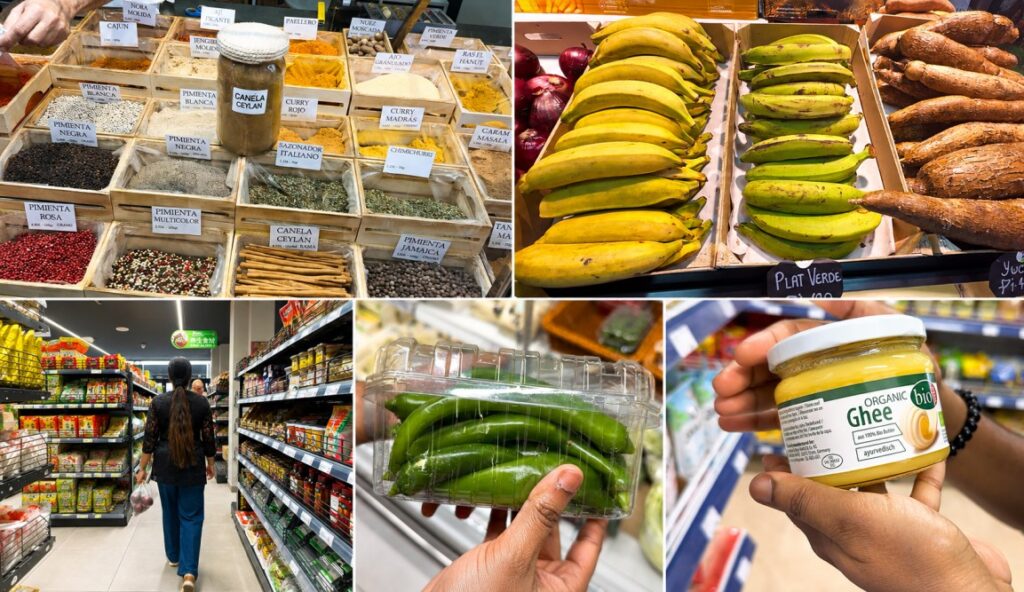
The fruit stalls almost always carry platano macho (plantain) and yuca (tapioca), which is our tapioca, is fully possible here. The carniceria (meat shop) stocks beef, mutton, chicken, turkey, pork and even rabbit. Fresh fish typically runs EUR 8 to 15 per kg (approx. Rs 880 to 1,650) depending on the variety.
💬 “There is a tiny spice store near us that became our happy place. The owner weighs out cardamom, cloves, cumin and tandoori masala by the gram, just like the old spice store in our hometown. Walking in there for the first time, the smell hit us and for a second we forgot we were in Madrid at all.”
Where Can You Find Curry Leaves, Mustard Seeds and Papad?
Now for the items that no Spanish supermarket stocks. Our black mustard (kaduku), curry leaves (kariveppila), ghee and papad etc. simply are not on those shelves. For these you depend on Asian grocery stores, and they are a treasure chest. Pretty much every Indian item you can think of is there – coriander powder, chilli powder, toor dal, urad dal, chana, basmati rice and so on.
And it is not just cooking basics. If a sudden craving hits for mixture, pani puri or kadala mittai, these shops have your back. A bunch of fresh curry leaves usually costs around EUR 1.50 (approx. Rs 165), which still makes us smile, because back home it grew in the backyard for free.
Which Shops Have the Most Indian Vegetables?
Here is a tip not many people share – for the widest range of Indian vegetables, the Chinese supermarkets are unbeatable. The variety of vegetables there are honestly surprising. Spicy green chilli, okra, elephant foot yam, colocasia and yardlong beans are regulars on the shelf.
Occassionally you will even spot drumsticks and Malabar spinach, which feels like winning a small lottery when you are craving a proper sambar or a thoran. These shops also carry whole dried red chilli, coriander, the powdered spices, and even tamarind. Green chilli usually sits at about EUR 3 to 4 per kg (approx. Rs 330 to 440).
So between the spice store, the Asian store and the Chinese supermarket, you can recreate almost any Indian dish you grew up with. It just means making two or three seperate stops instead of one – a small price for eating like home.
How Do You Buy Indian Groceries Online in Spain?
If you live in a small town with no Indian shop nearby, do not worry one bit. Several trusted online stores deliver Indian groceries across the whole country, and this is genuinely how a lot of our friends in smaller towns shop now. Delivery is typically a few working days, and ordering with neighbours to hit the free-delivery threshold is a smart move. It is definately the easiest option for anyone outside the big cities.
How Much Do Indian Groceries Cost in Spain?
Prices feel higher than India at first glance, but remember you are also earning in Euros. A couple cooking Indian food at home comfortably spends around EUR 350 to 450 a month (approx. Rs 38,000 to 50,000) on groceries, with Mercadona and Lidl being the cheapest mainstream options. We broke this down fully in our cost of living in Spain guide, and it helps a lot to know what salary you actually need in Spain before you stress about food bills.
Here is the simple shopping map we wish someone had handed us on day one:
| Where to Shop | Best For | Typical Price |
|---|---|---|
| Mercadona / Lidl | Milk, eggs, veg, meat, fish, round rice, whole spices | Milk EUR 0.90 (Rs 100) |
| Mercado Municipal | Fresh fish (cleaned free), meat, plantain, yuca | Fish EUR 8-15/kg (Rs 880-1,650) |
| Spice Store | All whole and powdered Indian masalas by the gram | EUR 1-3 per 100g (Rs 110-330) |
| Asian Store | Curry leaves, mustard, ghee, papad, dal, snacks etc. | Curry leaves EUR 1.50 (Rs 165) |
| Chinese Supermarket | Green chilli, okra, yam, taro, long beans, tamarind etc. | Green chilli EUR 3-4/kg (Rs 330-440) |
| Online | Everything, delivered to small towns and villages | Low or free delivery on big orders |
Final Thoughts
We worked all of this out ourselves, store by store. You are fully capable of doing the same with a little curiosity and a few weekend walks around your neighbourhood.
So when you pack for Spain, leave the chilli powder and the kappa behind. Bring your appetite and your recipes instead. The first time you make a proper fish curry with sardines cleaned at the local market, served over round rice, you will realise that home is something you can rebuild anywhere – even five thousand kilometres away.
Have a doubt about a specific ingredient or shop in your city? Drop it in the comments and we will share whatever we know from our own experience. We are always happy to help.
Frequently Asked Questions
Can you get curry leaves in Spain?
Yes, fresh curry leaves are sold in almost every Indian and Asian grocery store across Spain. They are not stocked in mainstream supermarkets like Mercadona, so head to an Asian shop or order online for around EUR 1.50 (approx. Rs 165) a bunch.
Is matta rice available in Spain?
Pure Kerala matta rice is hard to find on regular shelves, but Asian stores and online grocers like Dookan do stock it. For daily use most Malayalis happily switch to arroz redondo, the local round rice, which also works for idli and dosa.
Where can Indians buy fish in Spain?
The mercado municipal and the pescaderia counters in big supermarkets carry tuna, mackerel, sardines and anchovies. The fishmonger will clean and cut your fish for free, so you take home ready-to-cook pieces without any extra charge.
Do I need to bring Indian spices when moving to Spain?
No, there is no need to fill your suitcase with masala. Every common Indian spice is sold here by the gram in spice stores or in sealed packets at Asian shops, so you can travel light and buy fresh once you arrive.
Are Indian groceries expensive in Spain?
They cost more than in India in rupee terms, but you also earn in Euros, so it balances out. A couple cooking Indian meals at home spends roughly EUR 350 to 450 a month (approx. Rs 38,000 to 50,000) on groceries.
How do I buy Indian groceries if I live in a small Spanish town?
Trusted online stores such as Dookan, Cosmo Cash and Carry and Sultan Spices deliver across the whole country, including villages. Ordering with neighbours to reach the free-delivery threshold keeps it cheap and convenient.
Found this helpful? Share it with someone planning to move to Spain. Subscribe to our Life in Spain for Indians YouTube channel for real, honest videos about life in Spain – and follow us on Instagram for daily updates: Spain News for Indians.