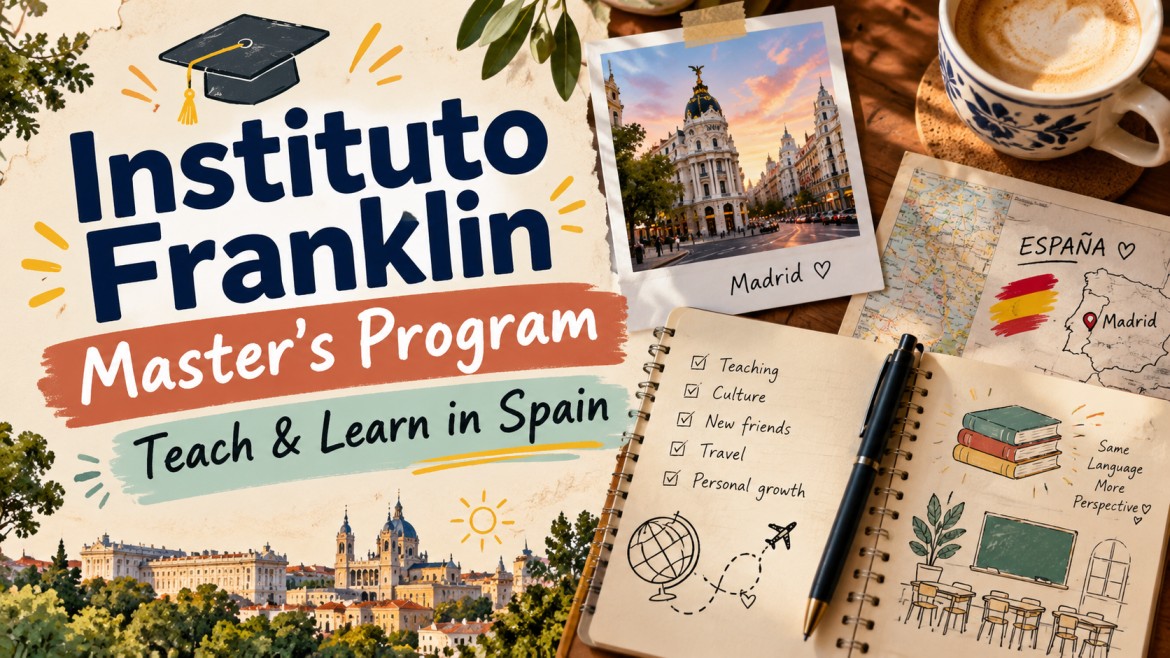
Instituto Franklin’s Masters Program : Teach & Learn in Spain
If you are an Indian graduate wondering whether you can do a master’s in Spain and get paid to work in a school at the same time, the answer is yes. Instituto Franklin, part of the Universidad de Alcala in Communidad de Madrid, runs a program called Teach & Learn in Spain, and India is officially on its list of eligible passport countries. You study for a master’s degree in education while working as an English language assistant in a Madrid-region school, usually with a monthly stipend.

One thing to clear up first: Instituto Franklin is not an English language school where you go to learn English. It is a university institute focused on North American studies and bilingual education. If you were searching for “language schools in Madrid” and landed here, this program is for people who already speak English at a native or near-native level and want to teach it, not study it.
Instituto Franklin Teach & Learn: Quick Summary
Teach & Learn is a one-year program (September to June) worth 60 ECTS credits, accredited by the Universidad de Alcala. You choose one of seven master’s programs and spend the year combining classes with school placement work in the Comunidad de Madrid. Tuition is €4,400 (approx. ₹4,40,000), but one funding option waives tuition completely. Applications for the 2026-2027 intake ran from January to March 2026, so if you are reading this now, you are planning for the next cycle. Most importantly, the program states clearly that it does not work with any agents – you apply directly, and you should never pay a middleman.
📌 Official Resource: The main Teach & Learn in Spain page lists all master’s programs, partner schools and the latest admissions notices. Visit Official Website
Watch Full Video👇
Instituto Franklin Master’s Programs: Seven Choices in Education
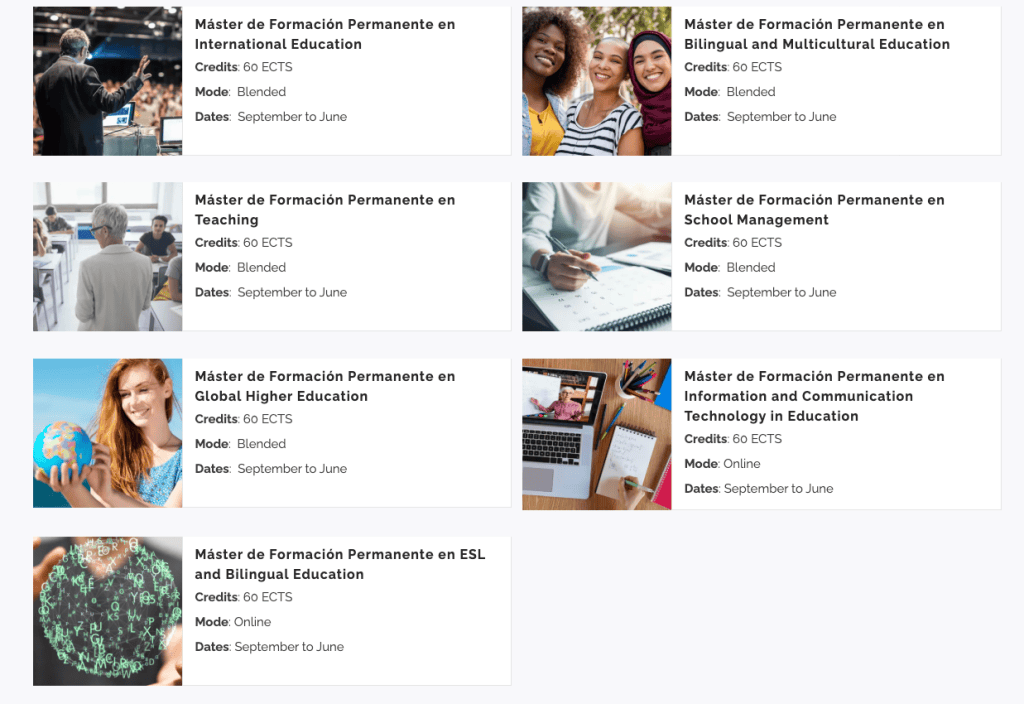
Every Teach & Learn student enrols in one master’s program. All of them are 60 ECTS and run from September to June. Five are blended (in-person plus online) and two are fully online:
- International Education (Máster de Formación Permanente en International Education – blended): A broad option if you want to work in international schools or education policy later.
- Bilingual and Multicultural Education (Máster de Formación Permanente en Bilingual and Multicultural Education – blended): The closest fit to what you actually do in the classroom as a language assistant.
- Teaching (Máster de Formación Permanente en Teaching – blended): Focused on classroom practice and teaching methods.
- School Management (Máster de Formación Permanente en School Management – blended): For people thinking about leadership or administration roles in schools.
- Global Higher Education (Máster de Formación Permanente en Global Higher Education – blended): Useful if you see yourself working in university international offices or student mobility.
- ICT in Education (Máster de Formación Permanente en Information and Communication Technology in Education – online): Educational technology, digital classrooms and e-learning.
- ESL and Bilingual Education (Máster de Formación Permanente en ESL and Bilingual Education – online): Teaching English as a second language, delivered fully online.
Some programs have subjects taught in Spanish, and for those the institute recommends B2 (intermediate) Spanish. If your Spanish is still basic, read our honest take on do you need Spanish to study here before choosing.
📌 The degree is a university title rather than an official master’s. Read the official pages yourself, attend an information session, and ask admissions every question you have.
Two kinds of master’s in Spain
- Máster Universitario (official): Approved and registered by the Spanish state, valid across Spain, and generally the route into a PhD or regulated professions.
- Máster de Formación Permanente (university’s own title): Designed and issued by the university itself, here the Universidad de Alcalá. These used to be called títulos propios, and Spain renamed them under its 2021 university law.
All seven Teach & Learn programs are this type.
What it means for a student :
- It’s a genuine university degree from a public Spanish university, with 60 ECTS. It’s useful for teaching experience, CVs, international schools and private-sector jobs.
- It isn’t automatically treated as an official master’s. Using it for PhD admission, Spanish homologation, government jobs, or equivalence in India (for example through AIU) may not work, or may need extra checks.
- So if someone needs the degree for an official purpose, they should confirm with that institution before applying.
Teach & Learn Eligibility: Can Indian Passport Holders Apply?
Yes. India is named on the official list of eligible passports, alongside countries like the UK, USA, Canada, Australia, Ireland and the Philippines. Here is what you need:
- A bachelor’s degree: Completed before the program starts. Final-year students can apply if their university confirms in writing that they will graduate by the deadline date (it was 1 June for the 2026-2027 intake).
- A 3.0 GPA on a 4.0 scale: Indian percentages and CGPAs will need to translate to this level, so check your transcript early.
- Native or near-native English: The institute follows the English level rules of the Spanish Ministry of Education’s language assistant program. If the Ministry asks candidates from your country for a proficiency certificate, you will need one too.
- Spanish (recommended): B2 level for master’s programs with Spanish-taught subjects.
Teach & Learn Tuition and Funding: How Much Does It Really Cost?
This is where most people get confused. There are three funding options, and the cost changes completely depending on which one you get:
- Option A (charter and private schools): Tuition is waived. You receive a stipend and health insurance from the Fundacion General de la Universidad de Alcala. You pay the €150 (approx. ₹15,000) application fee and a €500 (approx. ₹50,000) deposit, which is returned when you graduate. Spots are limited and not guaranteed.
- Option B (public schools): You pay €4,400 (approx. ₹4,40,000) tuition, but receive a stipend and medical insurance through the Ministry language assistant program. The first €500 is due on acceptance, the rest in instalments. Paying the remaining balance in one go drops it from €3,900 (approx. ₹3,90,000) to €3,700 (approx. ₹3,70,000).
- Option C (no placement): You do not get an assistantship placement through the program, so there is no stipend from it. You pay full tuition plus medical insurance, which means you need to fund your living costs yourself.
Warning: apart from the Option A deposit, all payments to Instituto Franklin are non-refundable. The deposit is also lost if you withdraw or fail to complete the program. Stipend amounts depend on your assistantship hours and are not published as one fixed figure, so ask admissions directly before you build your budget around them.
📌 Official Resource: Full breakdown of fees, deposits, insurance costs and the refund policy for all three funding options. Visit Official Website
Ministry Language Assistant Program for Indians: Why It Matters for Option B
Option B depends on the Spanish Ministry of Education’s language assistant program (auxiliares de conversacion). When Instituto Franklin last updated its pages, the 2026-2027 Ministry call had not been announced, and it advised applicants to keep a backup funding plan.
Since then, there has been good news for Indians. The Ministry published its 2026-2027 call in May 2026, and its India office confirmed that the program for Indian citizens has resumed. A few points worth knowing:
- No registration fee: The Ministry does not charge anything to apply. Anyone asking you for money to “get you in” is not official.
- Two-year limit for Indians: Indian assistants can stay in the program for a maximum of two school years, even with a visa renewal.
- Passport validity: For the 2026-2027 cycle, passports had to be valid until at least 1 November 2027, as the program was set to start on 1 November 2026.
- Supervised role: Assistants support conversation practice under a qualified teacher. The new call also lists activities assistants are not allowed to do, such as tasks that belong only to teachers.
Before choosing Option B, email Instituto Franklin admissions and ask exactly how Option B works for Indian applicants in your cycle. If you are already an assistant in this program, the institute asks you to email them before applying to confirm eligibility.
📌 Official Resource: The Spanish Ministry of Education’s India office page with requirements and updates for Indian language assistants. Visit Official Website
Instituto Franklin Teaching Methods: The Hybrid Model in Madrid Schools
The teaching and learning approach is built around one idea: you learn the theory of education in your master’s classes and test it every week in a real classroom. Instituto Franklin calls this a hybrid learning model.
- School placement: You work as a language assistant in a school in the Comunidad de Madrid.
- Blended classes: Most master’s programs mix in-person sessions with online work, so your coursework fits around your school timetable.
- Research focus: The institute researches bilingual education and co-organises an annual bilingual education seminar with the Comunidad de Madrid, which shapes what you study.
- Information sessions: Virtual information sessions are offered for prospective students. Join one before applying and ask your real questions there.
Life in Alcala de Henares: Visa, Budget and Getting Around
Instituto Franklin is based at the Colegio de Trinitarios in Alcala de Henares, a historic university town east of Madrid. Your school placement could be anywhere in the Madrid region, so think about commuting before you sign a rental contract.
- Visa: As an Indian citizen you will need a long-stay student visa from the Spanish consulate that covers your area. Start as soon as you get your acceptance letter. Our student visa FAQ for Spain covers the common questions.
- Getting around: Alcala is connected to Madrid by Cercanias commuter trains, so living in either place is workable depending on where your school is.
- Housing: Wait until you know your school location before committing to a flat. Read our guide on renting an apartment in Spain to avoid deposit scams.
- Budget: A stipend helps, but it is meant to support living and transport costs, not to fund savings. Check the real numbers in our cost of living in Spain breakdown.
For a wider picture of what the year actually feels like day to day, our guide to student life in Spain is a good next read.
Teach & Learn Checklist: What to Prepare and When
| Task | When | Notes |
|---|---|---|
| Check GPA and English requirements | Before applications open | 3.0 on a 4.0 scale; follow Ministry English rules |
| Attend a virtual information session | Autumn to winter | Ask about Option B for Indian passport holders |
| Get university graduation letter | Before applying | Only if you have not graduated yet |
| Scan documents as PDFs under 2 MB | Before applying | Name must match passport exactly |
| Record 3-minute application video | Before applying | Send via WeTransfer, max 2 GB |
| Pay application fee | At submission | €150 (approx. ₹15,000), non-refundable |
| Pay deposit or first payment | On acceptance | €500 (approx. ₹50,000); missing it cancels your offer |
| Renew passport if needed | On acceptance | Ministry route needed validity to Nov 2027 for 2026-2027 |
| Apply for student visa | Right after acceptance | Spanish consulate covering your area |
| Arrange housing | After school placement is confirmed | Factor in your daily commute |
Common Mistakes to Avoid with Teach & Learn
- Paying an agent: Instituto Franklin says clearly it does not use agents or intermediaries, and applications from third parties will not be considered. Anyone charging you to “arrange” admission is wasting your money.
- Assuming tuition is free: Only Option A waives tuition, and those spots are limited. Budget for €4,400 (approx. ₹4,40,000) in case you end up in Option B or C.
- No backup funding plan: Option B depends on the Ministry program, and the institute itself advises having an alternative plan.
- Ignoring the Spanish requirement: Choosing a master’s with Spanish-taught subjects without B2 Spanish will make the year very hard. Our guide on how long it takes to learn Spanish helps you plan realistically.
- Name mismatches on documents: Indian documents often have initials or swapped name orders. Fix these before applying, not after.
- Missing the deposit deadline: Accepted students who do not pay on time lose their offer.
Final Thoughts
For Indian graduates who love teaching and want a real way into Spain, Teach & Learn is one of the more practical routes out there. You get a university master’s, classroom experience in Madrid schools and, with the right funding option, a stipend to help with living costs. The fact that India is officially on the eligible list, and that the Ministry program for Indians has resumed, makes this a genuinely good time to look at it.
Just go in with clear eyes. Tuition is only waived in limited Option A spots, payments are non-refundable, and the degree is a university title rather than an official master’s. Read the official pages yourself, attend an information session, and ask admissions every question you have.
And please, do it yourself. The application is online, the requirements are published, and the institute has said in writing that it does not work with agents. Everything you need is on the official websites, and that is all you need to get started.
Frequently Asked Questions
Is the Instituto Franklin master’s an official degree?
The programs are titled Master de Formacion Permanente, which is a university’s own degree issued by the Universidad de Alcala, not an official Master Universitario. If you need the degree recognised in India for a government job, PhD admission or equivalence, confirm with that body before you apply.
Can I apply if I already live in Spain?
Yes. For the 2026-2027 intake, the deadline was even extended to 24 April 2026 for applicants already living in Spain. If you are currently a language assistant and want Option B, email admissions first to confirm your eligibility.
Will I have an interview?
Possibly. The admissions team may invite some candidates to a virtual interview, but the institute says those who are not interviewed are not at any disadvantage.
Found this helpful? Share it with someone planning to move to Spain. Subscribe to our Life in Spain for Indians YouTube channel for real, honest videos about life in Spain – and follow us on Instagram for daily updates: Spain News for Indians.