How to Plan a Northern Lights Trip to Tromsø, Norway: The Complete Guide
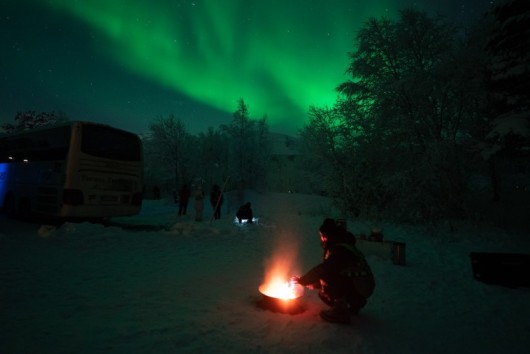
Seeing the northern lights in Tromso was on our bucket list for years, and we can honestly tell you it is worth every rupee and every frozen toe. It was around 12:30 at night, we were standing in the middle of a dark forest at minus 16 degrees Celsius, and suddenly the starry sky above us started moving like a green and red curtain swaying in the wind. As a couple who planned this whole trip ourselves from Madrid, here is everything we learned, so you can do it without paying an agent a single extra rupee.
What Are the Northern Lights, Really?
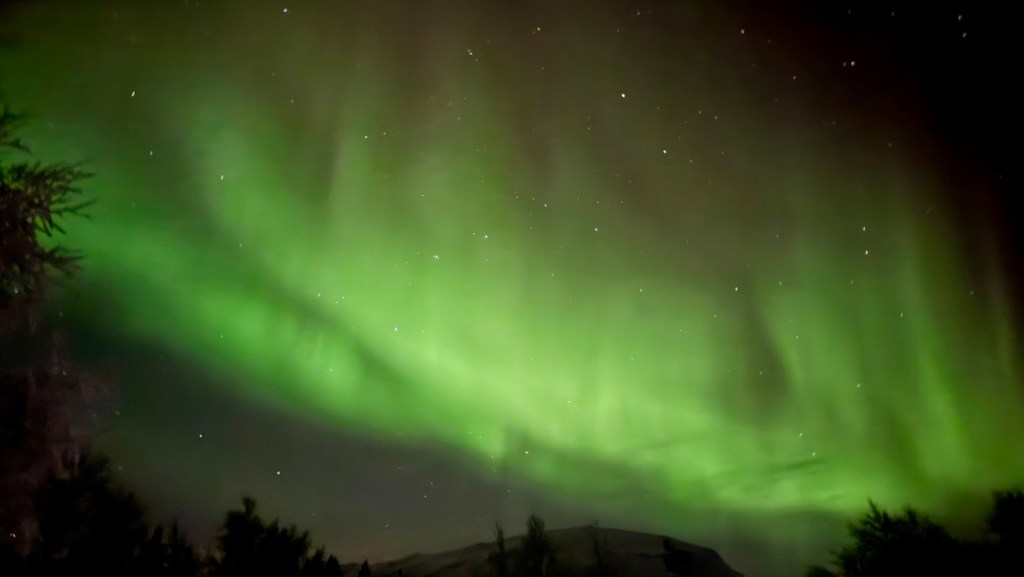
The Aurora Borealis, or Northern Lights, is a natural light show that happens mainly in the polar regions of our planet. It starts on the Sun. When the Sun has activity like solar flares or a coronal mass ejection, it throws out huge amounts of charged particles, mostly electrons and protons, into space. When these particles travel together at very high speed, we call it the solar wind.
This solar wind cannot directly enter the Earth because of our strong magnetic shield, the magnetosphere. Instead, the Earth’s magnetic field lines guide these charged particles towards the North and South poles. That is exactly why you see auroras in high-latitude places like Tromso, Finnish Lapland, Canada and Alaska, and not in Kochi or Dubai. Once the particles reach the upper atmosphere, mainly the thermosphere about 100 to 300 km above us, they crash into oxygen and nitrogen atoms.
Watch Our Aurora Experience👇
During these collisions, the atoms get “excited” and jump to a higher energy state. When they come back to their normal state, they release tiny packets of light called photons. Millions of these photons together are what we see dancing in the sky. The common green colour comes from oxygen, the rarer red from oxygen at higher altitudes, and the blue, violet and purple shades come from nitrogen. Once you know this, standing under the aurora feels even more magical, because you are literally watching the Sun hit our planet.
Conditions for Seeing the Northern Lights
Here is the honest truth nobody tells you in those glossy Instagram reels: the aurora is happening very often, but seeing it with your own eyes or even on camera needs several conditions to line up at the same time. And even when every app says “go”, there is no 100% guarantee. We think every Indian traveller should understand this before spending lakhs on a trip.
Why Does Light Pollution Matter?
If you are standing in a city or town, street lights, building lights and house lights fill the atmosphere with light pollution. A weak or medium aurora simply disappears against that glow. Only a really strong solar storm will be visible from inside a city. This is why every serious aurora chaser drives out of town into dark areas like forests, valleys and lakeshores.
How Important Is Cloud Cover?
This is the biggest challenge of all. Even if the solar activity is excellent, a sky full of thick clouds means you see nothing. Tromso has two problems here. First, it is a proper city with a fair amount of light pollution. Second, it is a coastal city, and its geography brings a lot of cloud cover. So to improve your chances, you either go to a high-altitude spot or drive away from the coast to areas with less clouds, sometimes even into Sweden or Finland.
Does the Moon Ruin Your Chances?
Moonlight is natural light pollution. On a bright full moon night, a faint aurora becomes hard to see. But here is the interesting part: if the solar activity is strong enough to shine through the moonlight, the aurora you see will be very bright and very beautiful, and the moonlit snow makes a lovely foreground for photos.
Here is a quick checklist we used before our night out:
- Darkness: Be far away from city lights, ideally 45 minutes or more outside town.
- Clear sky: Check the cloud cover forecast, not just the aurora forecast.
- Solar activity: Look at the Kp index, solar wind speed and density in your aurora app.
- Moon phase: A new moon week is ideal, but a strong aurora beats the moon.
- Patience: Be ready to stand in the cold for hours.
When Is the Best Time to Go?
In the northern hemisphere, the aurora season runs roughly from late September to the end of March. After that, the nights become too short and bright, so you simply cannot see it. Within the season, each month feels quite different.
| Month | Darkness | What to Expect |
|---|---|---|
| September – October | Good | Milder weather, autumn colours, fewer crowds, often cheaper tours. |
| November – January | Very long nights | Maximum dark hours, polar night in Tromso, heavy snow and slippery roads. |
| February – March | Good | Colder but often clearer skies, daylight returning, great for snow activities. |
| April – August | Too bright | No aurora visible, midnight sun season instead. |
Why Did We Choose a Chase Tour in Tromso?
Tromso sits well inside the Arctic Circle, so it satisfies the location condition perfectly. But because of the city lights and the coastal clouds we mentioned, we decided that for our first time, a local chase tour was the smartest way to improve our odds. We researched reviews ourselves and booked directly with a Tromso-based company called Chasing Lights. No travel agent in between, no inflated package.

What we liked about them is their network. Their guides and other tour teams are spread across Norway, Sweden and Finland, and they keep sharing real-time information with each other throughout the evening: where the clouds are, where the sky is clear, and where auroral activity is picking up. Based on this, the bus or van simply drives to wherever the chances look best. Sometimes that is an hour away, sometimes it means crossing into Finland. Their own tour page mentions that the route can go along the coast, inland, or even over the border.
How Does an Aurora Chase Tour Work?
You meet at a central point in Tromso in the evening, the guides study the forecasts, and then you drive, stop, check the sky, and move again if needed. Chasing Lights asks guests to meet at the Prostneset bus terminal at Tromso harbour, and they are very clear that the tour runs in all weather and there are no refunds if the aurora does not appear. Return time can be anywhere from late evening to around 3 AM, so dont plan anything early the next morning.
📌 Official Resource: Visit Tromso, the official tourism board, has updated details on getting around the city, airport buses, taxis and city bus tickets. Visit Official Website
What Happened on Our Aurora Night?
Our tour started on 19 November at around 5:40 PM. We reached the collection point by 5:15 and everyone was already waiting, wrapped up like walking sleeping bags. The bus arrived, we got in, and we met our two guides, Mark and Bailey. For the whole night they were on the phone with other teams, spotting the right location, and at the same time entertaining us with aurora facts and funny Arctic stories. A special thanks to both of them.
About an hour into the trip, they got information that the cloud cover was low around Skibotn, a small place close to the Finnish border. So off we went. The bus stopped a little away from the main road, the guides lit a small campfire, and handed out hot cranberry juice and cookies they had brought themselves. It was freezing, but sipping that warm juice beside the fire under a sky full of stars is a feeling we still talk about.
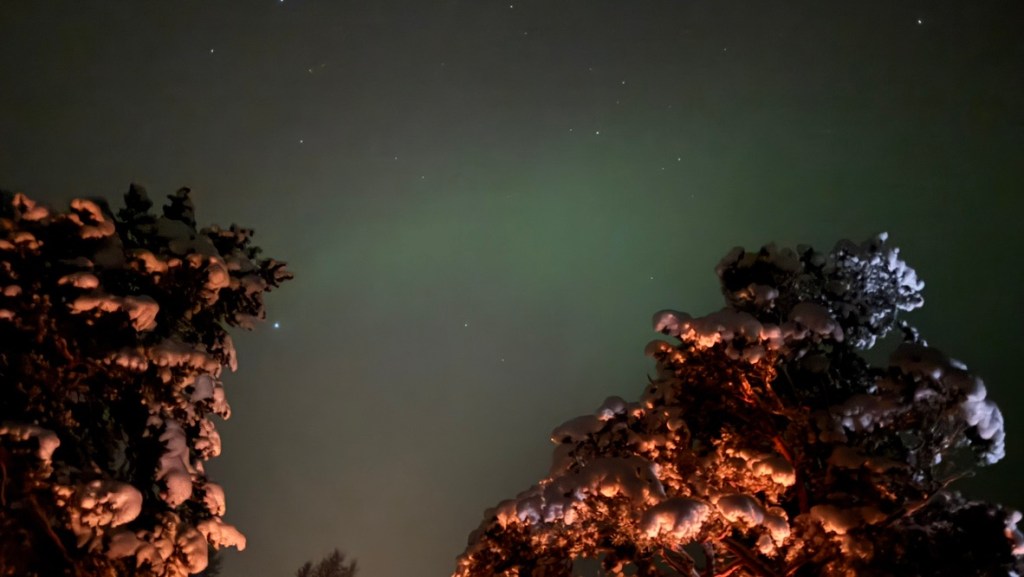
Mark and Bailey kept reminding us to be patient. All the apps can show perfect readings for solar wind speed, density and Kp index, and still nobody can say exactly when the aurora will come or how strong it will be. So we stood there, necks bent, staring at the sky. After about 30 to 45 minutes, a faint arc appeared across the sky, like a pale rainbow. To our eyes it looked like a grey cloud in the dark. But when we took a photo with a long exposure, the screen showed clear green. That is simply because our eyes cannot collect as much light as a camera sensor can.
A little later, the arc started spreading. Within minutes the whole sky was filled with bright green, clearly visible to the naked eye, with touches of red, moving exactly like a curtain in the wind. We honestly forgot to take photos and videos for a while. You just stand there. This is one of those moments that you have to experience yourself, because no video does it justice. We beleive it is one of the best nights of our life so far.
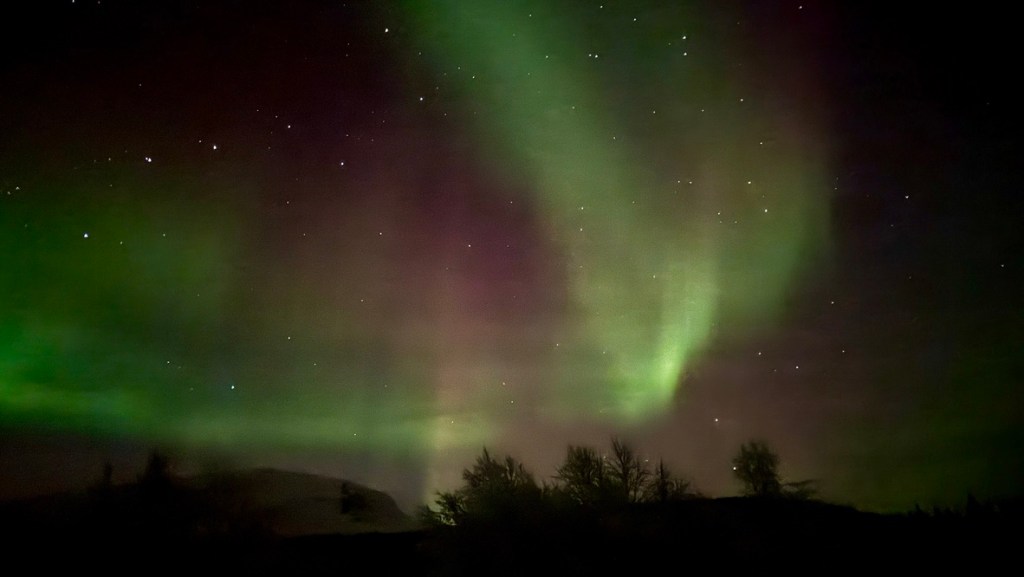
We did not carry our DSLR that night, only an iPhone. Mark and Bailey, who specialise in night photography, showed us the right phone settings and also shared photos from their professional cameras with us. Most of the pictures we posted are from them. People who went on the previous nights told us they could only see the aurora on camera, not with their eyes, so we know how lucky we were.
So let us be real with you: like whale watching in the Arctic, this is not a 100% comfortable experience. It is cold, it is late, and you will be tired. But it is an adventure that is absolutely beautiful, and worth all of it.
Can You Chase the Aurora on Your Own?
Yes, you can. If you have a valid driving licence, you can rent a car and drive to dark spots yourself. But please do this only if you have real experience driving on snow and ice at night. During our visit the roads were extremely slippery, full of snow and ice. You need proper snow tyres, and sometimes snow chains, fitted before you go. People who came without doing this research and just rented the cheapest car told us they turned back within 30 minutes because they got scared on the icy roads.
Inside Tromso city, getting around is easy and cheap. We used the Svipper app to buy local bus tickets. A single city ticket costs around NOK 50 (approx. €4.3 / ₹430), with a cheaper off-peak fare of about NOK 30 (approx. €2.6 / ₹260). Tickets cannot be bought on board city buses, so download the app and add your card before you land.
📌 Official Resource: Svipper is the official public transport operator for the Troms region. Use it for bus tickets, timetables, route maps and real-time bus tracking. Visit Official Website
Best Aurora Apps for Tracking the Northern Lights in Tromsø
Whether you take a tour or go on your own, these are the apps we used ourselves. Each of these apps give you a slightly different piece of the puzzle, so we recommend installing all of them.
- Hello Aurora – aurora forecasts plus live sighting reports from other users nearby.
- Aurora – simple aurora probability forecast with notifications.
- SpaceWeatherLive – detailed Kp index, solar wind speed, density and magnetic field data.
- Norlys – aurora forecast with a clear map of where activity is likely.
- Windy.app – cloud cover and weather forecast, which is just as important as the aurora forecast.
- Svipper – for local bus tickets in Tromso.
Our tip: don’t only look at the Kp index. Check the cloud cover first, because a Kp of 5 is useless under thick clouds, while a Kp of 2 can give a lovely show under a perfectly clear dark sky.
How Much Does a Tromso Aurora Trip Cost?
The good news is that a Northern Lights trip does not need a luxury package. The biggest costs are flights, accommodation and one good tour. Tour prices vary a lot by vehicle size. A big bus chase is the budget option, while small minibus groups cost more but give you more flexibility and personal attention. Low season months like September and October are often cheaper.
| Item | Approx Cost | Notes |
|---|---|---|
| Schengen visa (from India) | €90 (approx. ₹9,000) + VFS service charge | Apply through VFS; Indians in Europe with residence permits dont need it |
| Big bus aurora chase | From about $131 (approx. ₹11,500) | Cheapest guided option, up to 50 guests |
| Small group minibus chase | From about €160 (approx. ₹16,000) | More flexible, fewer people, photos often included |
| Tromso city bus (Svipper) | NOK 50 (approx. €4.3 / ₹430) | Cheaper off-peak fares available |
| Fjellheisen cable car | About $25 (approx. ₹2,200) | Elevated viewpoint above city lights |
| Arctic clothing rental | From €53 per day (approx. ₹5,300) | Jacket, trousers, boots and mittens |
For Indians applying from India, Norway is part of the Schengen area, so you need a regular Schengen short-stay (Type C) visa. If Norway is your main destination, apply for it through the Norwegian embassy’s VFS centres in India.
📌 Official Resource: The Royal Norwegian Embassy in New Delhi explains where and how applicants in India should submit a Schengen visitor visa for Norway. Visit Official Website
📌 Official Resource: VFS Global’s official Norway visa page for India lists service charges, application centres and appointment booking. Visit Official Website
A few money-saving tips from our own trip: book the aurora tour for your first night, so if it fails you still have more nights to try again. Stay at least 3 to 4 nights in Tromso, because weather is the real boss here. And carry your own thermals, woollen socks and gloves from home or from Decathlon, because renting everything adds up quickly.
Final Thoughts
Seeing the northern lights in Tromso is not just a travel tick-box, it is a moment that stays with you forever. Standing in a silent forest near the Finnish border, holding a cup of hot cranberry juice while the sky turns green above you, is something we will definately never forget. Yes, it was cold, yes our feet froze, and yes we waited a long time. Every bit of it was worth it.
And the best part is that you do not need an agent to make this happen. We planned the flights, the stay, and the tour completely on our own, just by researching carefully and reading reviews. Use the apps we listed, book a flexible local chase tour directly, give yourself enough nights, and pack proper winter clothes. That is really all it takes.
Frequently Asked Questions
Is it guaranteed to see the northern lights in Tromso?
No, it is never guaranteed, even with a guided tour and perfect app readings. Clouds, moonlight and weak solar activity can all spoil a night, which is why we recommend staying at least 3 to 4 nights.
Which month is best to see northern lights in Norway?
The season runs from roughly late September to late March. November to January gives the longest dark hours, while February and March often bring clearer skies and slightly easier weather.
How much does a northern lights tour in Tromso cost?
A big bus chase starts at around $131 (approx. ₹11,500) per person, while small group minibus tours start around €160 (approx. ₹16,000). Most operators do not refund you if the aurora does not appear.
Do Indians need a visa for Norway?
Yes, Indian passport holders need a Schengen Type C visa, with a visa fee of €90 (approx. ₹9,000) plus VFS charges. Indians living in the EU with a valid residence permit can usually travel to Norway without a separate visa.
Can I see the northern lights with my naked eye?
Yes, but only when the activity is strong enough. Weak auroras often look like a grey cloud to the eye, while a camera with a long exposure shows them clearly green.
Is it safe to drive myself to chase the aurora?
Only if you have real experience driving on snow and ice at night. Roads around Tromso get very slippery in winter, and you need snow tyres and sometimes chains.
Found this helpful? Share it with someone planning to move to Spain. Subscribe to our Life in Spain for Indians YouTube channel for real, honest videos about life in Spain – and follow us on Instagram for daily updates: Spain News for Indians.
6 Comments